My Herniated Disc and Sciatica story
This is a story of my herniated disc, sciatica pain, and recovery process and timeline. I find most of these stories poorly documented and with too many unanswered questions, so here’s my case in full.
I’m a fit, active person in my mid-40s, and so am writing this in case you relate. Every case is different.
In mid-May 2025, I herniated a disc in the lumbar region. I knew I had immediately. I was doing some lifting at my gym, Absolute MMA — taking time out from Jiu Jitsu because, ironically, I had hurt my neck in sparring. I thought I’d spend that time regaining some much-needed strength. I didn’t expect to hurt myself in the process.
This article is long-form, trying to answer all the questions you might have. I’m not a medical professional, and still just one person.
The Herniation (late May 2025)
I’m a good lifter. Strong enough and with good form. But I’m in my forties, so despite being in good shape, my body has some wear on it. Let’s start with that.
I’ll be verbose here so you can get a good sense of who I am, to see how you relate.
Backup — I’ve been lifting consistently for over a decade. I started lifting in 2014 in a Crossfit gym in Hong Kong. Learned a lot, developed a few not-so-great habits, but had them ironed out of me in a super high-end gym in San Francisco. In fact, they built me up from scratch — I dropped weights and never did a rep of which they wouldn’t approve. I’ve always prided myself on good form, not letting ego get the better of me, and focusing on function over form.
I got bored of Crossfit but did set myself a goal of getting very strong. With a personal trainer, I did a lot of training and eventually got myself to a 1000-lb total. (Why 1000 lb and not 500 kg? Well, because it was slightly lower! They’re all just numbers, anyway.) I hit a 190 kg deadlift, a 165 kg squat, and a 115kg bench. At that time, I was around 85 kg.
Soon after, I got bored. It didn’t make sense to keep getting stronger. “Why be so strong if I can’t use it?” So I found my first combat sports gym, Sassom MMA, in Brisbane, Australia. I was terrified of that, but I had the time of my life. After a week, my neck and back hurt like crazy, but I was hooked.
To this date, I’ve put nearly 1000 hours of training down and am a middling blue belt in my forties.
The thing is, since I started BJJ and Muay Thai / boxing, I almost stopped lifting. I just didn’t have time. Occasionally, I’d pick up a few weights (e.g. when an injury stopped me from training combat sports), but it was sporadic and unsystematic.
It’s safe to say I was losing peak strength over time, but I was still in good shape, strong enough, and fit. Besides, I was focusing on form in combat sports rather than strong-arming my way through things. Form over everything.
The consequence of this is that when I did occasionally pick up some weights, I was lacking some core strength, not to mention conditioning. That’s the context.
What happened was a conflagration of a few factors.
Firstly, I was lifting after a period of intermittent lifting, as mentioned.
Secondly, I didn’t warm up properly for this particular warmup. Back in the best gyms, I would condition and warm up for a while before attempting heavy lifts. I didn’t, this time.
Thirdly, I went too hard, too fast, on a lift I didn’t know well. We were doing trap bar deadlifts and it was my first time.

I consider myself a proficient deadlifter with the bar, but I hadn’t ever done the trap. I thought they were “easier”. So I jumped up in weights too quickly, from 120kg up to 160 kg.
I did one lift and it went up and down. “Trap bar lifts are easy,” I thought. I was overconfident. On the second one, I felt a “crick”, and knew I slipped a disc.
I immediately went and lay down. I could still walk, which was a good sign. And I took a few days off training… but then came back to it. I just avoided folding too much, and took time off Jiu-Jitsu. But I didn’t stop for a couple of weeks — when the sciatica pain made it clear I couldn’t continue.
You’re reading this and thinking, “this was avoidable,” and “your ego got the better of you,” and of course, you’re right. But it doesn’t help, and that doesn’t prevent it from happening to me again or to others.
The thing is, if you know me, you’d know that I’m a gentle dude, not some bro (I mean, I’m a writer!), and I’m disciplined. I just want to emphasise we all have lazy moments, we all push our limits at some point, and we find them the hard way. Plus, we age, without realising it, and our bodies change. It can happen to you.
My Sciatica Pain Levels
Sciatica pain hits everyone differently. Some people can barely move. Mine really only seemed to kick in a couple of weeks after the initial herniation. It might have been because I kept training — I don’t know. But here’s how it hit me.
The cause of the pain was a herniation of the S1/L5 disc, but the result was inflammation of the sciatica nerve down my left leg. Once the back pain subsided, the nerve pain remained.
In summary, it hurt to bend over or curl up. Once my lower back pain subsided, I’d get a sharp, stabbing pain all down my left leg — first in my buttocks, later in the back of my calf — from doing things like putting on a sock, or extending my left leg.
Walking would be fine for up to half an hour, but after that, I’d almost want to hobble home. If I tripped up while on my daily walk, I’d get such severe pain I’d wonder if I could get home… but I could.
Sitting down for extended periods became unbearable, even with painkillers. I switched to a standing desk, at which I’d get tired, so I couldn’t work as much.
Initially, I was taking ibuprofen (aka Neurofen, but an unbranded generic) and paracetamol (aka acetaminophen, aka Tylenol/Panadol) every day. I’ve had paracetamol poisoning before, so I was careful with that dose. But ibuprofen — you’re only supposed to take that for a few days, because it can mess up your stomach. So I saw a doctor for an alternative (more on that below).
My pain continued even when taking my long-term painkillers — 4 doses of paracetamol a day plus one dose of the anti-inflammatory. Those painkillers let me get through the day, but I still hated staying seated, standing up, or putting my socks on.
Initial treatment (June 2025)
Initially, I just went home and saw a physiotherapist, a dude named Kyle Haddad who just happened to live near my house — but who, luckily, provided attentive, high-quality care. I asked if I’d need an MRI, and he said I could get one, but that it wouldn’t affect initial treatment, so I put it off (a $300 expense deferred!)
I’m in Australia, so mostly covered by public health for serious things (like surgery), but many small things like physiotherapy and doctors are still out of pocket. So far, I’ve paid about $1500 in treatment (but this includes a corticosteroid injection), less than I’d ever have paid in insurance anyway, and not even including the gap (co-pay, in US terms).
My doctor prescribed me anti-inflammatory drugs that he said I could take four days a week for up to three months, rather than ibuprofen. I did take those, but took half the daily dose, and sometimes for five or six days a week if it was unbearable. Once it got to the unbearable levels, I knew I needed some other treatment.
The physio did the usual. He did a bunch of tests and said I had symptoms consistent with a herniated disc and compression on the S1 nerve root (in the lower back region). Initially, he gave me some light movement exercises, and graduated to nerve flossing. He also did massage and dry needling to ease the pain.
I did these exercises and switched my daily movement routine to just walking, cycling, and my dance classes. Thank goodness I had picked up dance, or I’d have no social outlet! Dance is gentle, but fun, and easy on the back. I actually think everyone should learn to dance, but that’s another topic.
Two months went by and… the sciatica pain was still there. My muscle pain in my glute and leg had diminished greatly, but the nerve was still compressed and the inflammation still present.
I got an MRI from a radiology clinic and confirmed that there was compression at the S1 nerve root. This at least ruled out more serious complications, but it also showed that we could really target that for recovery.
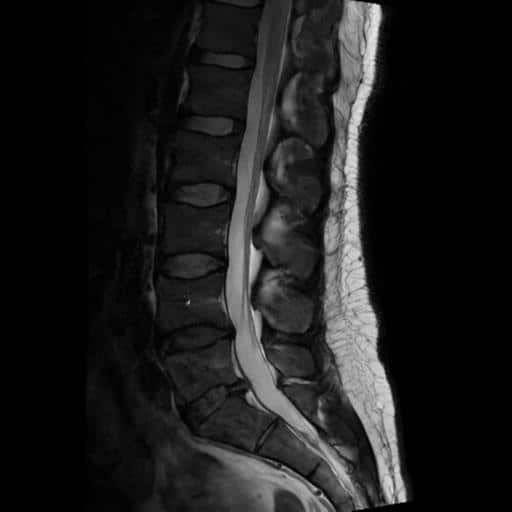
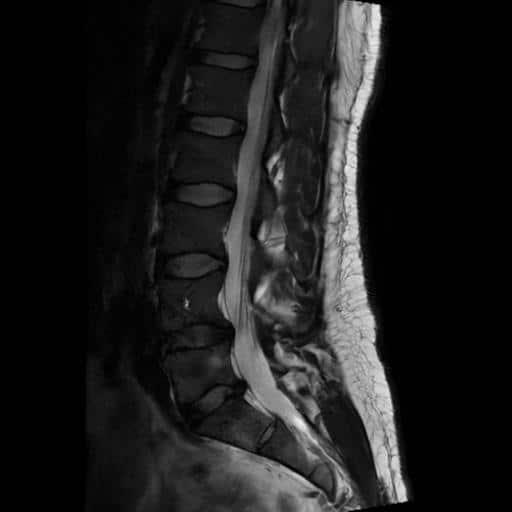
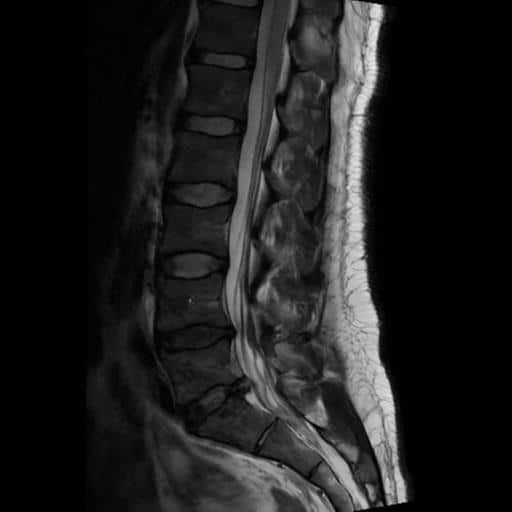
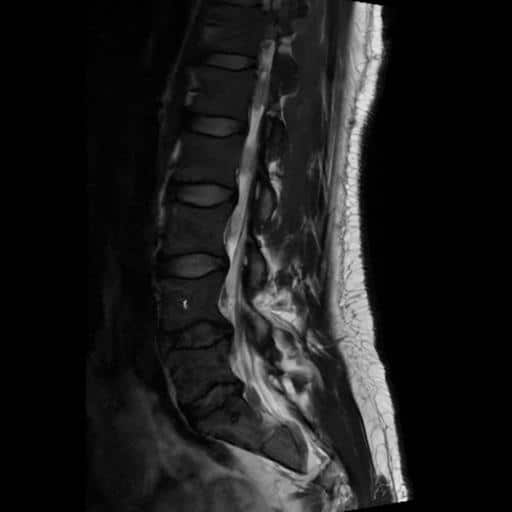
At this point, I had two options: a) tough out the pain and hope for recovery in the spine, or b) get treatment for the pain so I could do more active recovery. Treatment for the pain sounded good because the constant pain was interfering with my life.
Two benefits of treating the pain would also be that a) I could do rehab work that would prevent future re-injury, and b) I could do some more cardio work and stop putting on weight (and reverse it, hopefully!)
The Injection (September 2025)
The next phase in treatment was a CT-guided nerve root steroid injection into the S1 nerve root. I got a prescription from my GP and got it done at a radiology clinic. A radiologist does it under the guidance of a CT scan. I had this injection done in early September — just over 3 months post-herniation.
The injection was quick and easy. Just a couple of small pricks. First, the local anaesthetic, and then the injection. The radiologist looked at the imaging, and along with my symptoms, confirmed everything was consistent with an S1 nerve root inflammation. So that’s what he targeted.
I could still walk immediately after the injection, but was slightly wobbly. My partner drove me home. I didn’t do anything that evening (though I felt I could have!), but really, felt fine.
Of course, the anaesthetic was why I felt fine. Once that wore off (fully after a day or so), the pain did resume, and I resumed painkillers. These injections are supposed to take effect within 2-7 days, with the full effect being apparent after 2-3 weeks. They can last anywhere from weeks to months, but 3-6 months is normal. In that time, my spine is supposed to heal, but I can get another injection later if necessary.
But my injection hadn’t kicked in seemingly at all on days 3, 4, and 5.
On day 6 I actually was panicking slightly. I was still taking painkillers every day (including both paracetamol and the prescription anti-inflammatories), and while I perceived some effect, it was minimal. I just thought it had failed, or maybe it was the wrong treatment path.
But on day 7, I noticed a markedly greater effect. I got up with only slight pain, and got through the whole day comfortably just on paracetamol. After that, each day was a bit better, and I started to feel more confident the injection was a success.
Two weeks after the injection, I still wake up with mild pain — but it’s not excruciating. I can put on my pants and socks with just a bit of awkwardness. And I’m totally off using anti-inflammatories — which mess with digestion — and am just using paracetamol. This is far from ideal, but it’s an improvement.
I saw my physio and we’re a bit disappointed with the effects of the injection. We expected more.
Three weeks afterwards, the effect seems to have improved. I’ve started going to the gym again, though it’s mostly cardio and light weights. I’m not sure if it’s a coincidence, but one day last week I thought “screw it” and went on a 40km gravel bike ride, loaded up with anti-inflammatories first. In the days after that, the pain decreased. I do think it’s a coincidence because in prior attempts at long rides or walks I was in pain.
This is a work-in-progress post — I’ll update it with further results! But this is where I’m at right now.
Return to light training (October 2025)
In September 2025, around 4 months in, I started light rehab work. This was a mixture of light cardio (using the cross trainer and bike to start) and light callisthenics, plus some rehab-focused strength – lunges with weights, some bench, some ab stuff.
Over around two months I gradually scaled up to doing squats, doing sets of ten at 100 kg, doing rack pulls (the last pull of a deadlift) also at 100kg for sets of 5-10, and heavier bench, inclined bench, leg press, etc.
I also scaled up my callisthenics work, using heavier dumbbells, more reps, etc. I began to feel more confident.
Late in November, I started back in Jiu Jitsu and even started Crossfit (heck, the gym offered it… Resilience Training Centre in Footscray, Vic). I started taking it easy, and definitely needed painkillers to be able to go, but I surprised myself by being able to get through a session, minus the highest impact stuff. It’s good to get back on the mats, but I’m far from 100%.
The plan
I still don’t know if I’ll need more injections or even surgery.
What I’ve learned from this is to respect my back and to focus more on light weights and power output rather than one-rep-max pulls.
I think gone are my days of deadlifts at 2x body weight (I just don’t see the point). But I may revisit this later.