
Launching PaperTiger — Simulated Trading on Prediction Markets
I’ve been building a new thing: PaperTiger, a prediction-market paper-trading app. And I’m releasing it today!
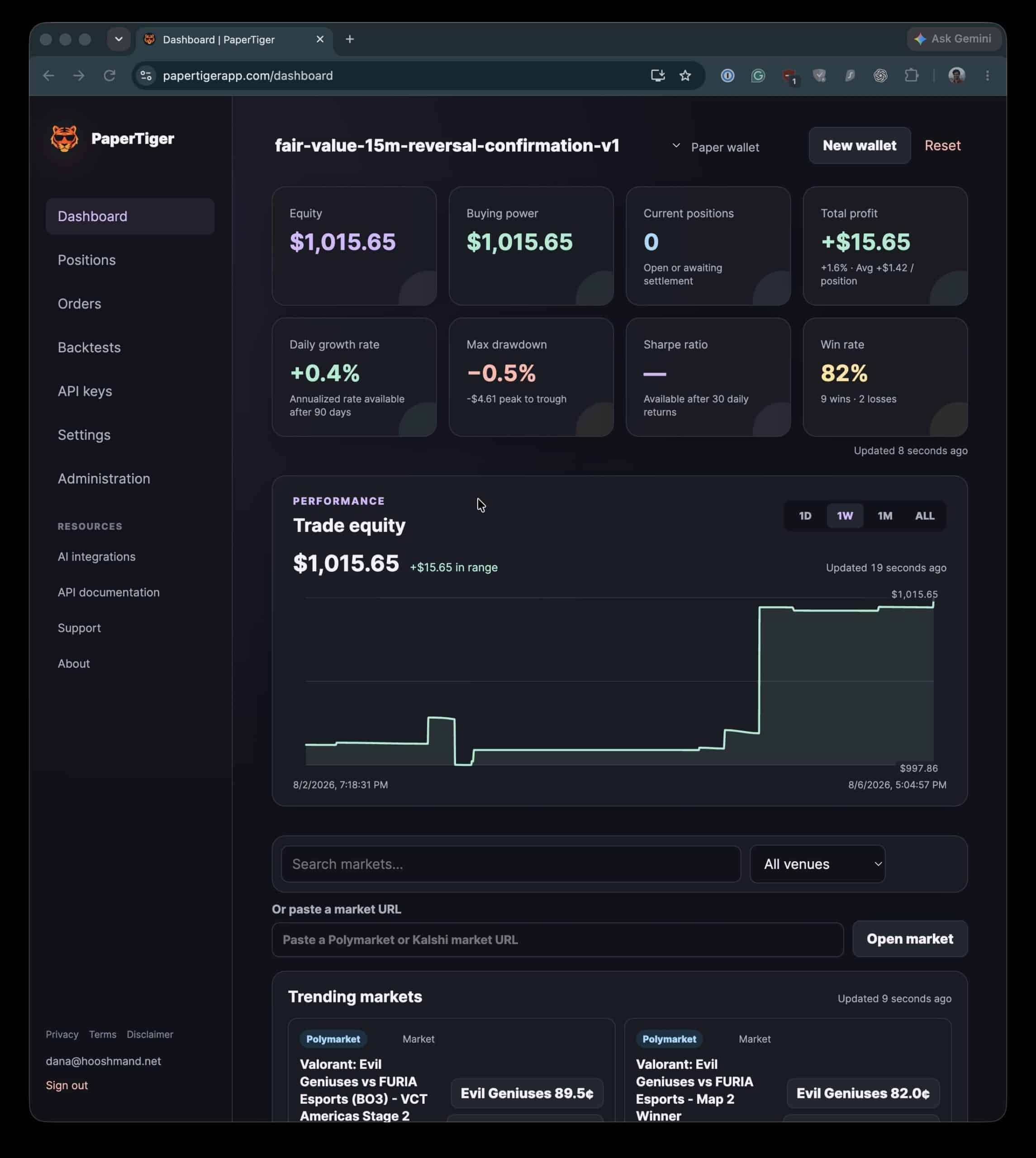
The TL;DR is that you can simulate trading on Polymarket and Kalshi without putting real money at risk. Search markets, create a virtual wallet (OMG you have $1,000! But not really), place simulated orders, and see what actually happens to your decisions over time.
This is an educational and research tool, not a real-money trading product, and it cannot place real-money venue orders… yet.
Why build this?
Prediction markets are fascinating. They combine a clear question, a price that moves as information changes, and just enough weirdness to make you think you have spotted something everyone else missed. That is also exactly why they are an easy place to confuse a nice theory with a good decision.
The conventional wisdom in algorithmic trading is to backtest comprehensively and intelligently. There are long discussions and many papers on eliminating biases, keeping robustness, adapting to regimes, performing against the correct measures or benchmarks, etc. But the complexity of backtesting is astounding because while you can describe an idea briefly (e.g. “Trade on market pressure from Binance l2 data at t-10 seconds on Polymarket”), it requires an astounding amount of data and computation to figure out what works. And then you have to factor in the notion that regimes change constantly.
So I find it easier to forward test right away. I have an idea, I code it, and I start testing it to see what happens. If it holds for a statistically significant period, great. If it doesn’t, adapt.
PaperTiger is my tool to help work through that problem. Rather than going straight from “I have an idea” to “I should risk money on it”, it gives me a place to make the hypothesis explicit and run it in a contained environment. I can practise discretionary trades, test how an agent behaves, keep strategies in separate virtual wallets, and inspect what happened afterwards. The wallet is fake, but the logic is real and the simulation attempts to mimic reality as best possible.
What makes PaperTiger different
You can paper trade on some platforms, but not all.
- It is deliberately paper-only. Every wallet balance and order is simulated. There is no “just connect your real account” button hiding around the corner.
- It works across Polymarket and Kalshi. You can explore current markets from both venues in one place and use their canonical market and outcome identifiers.
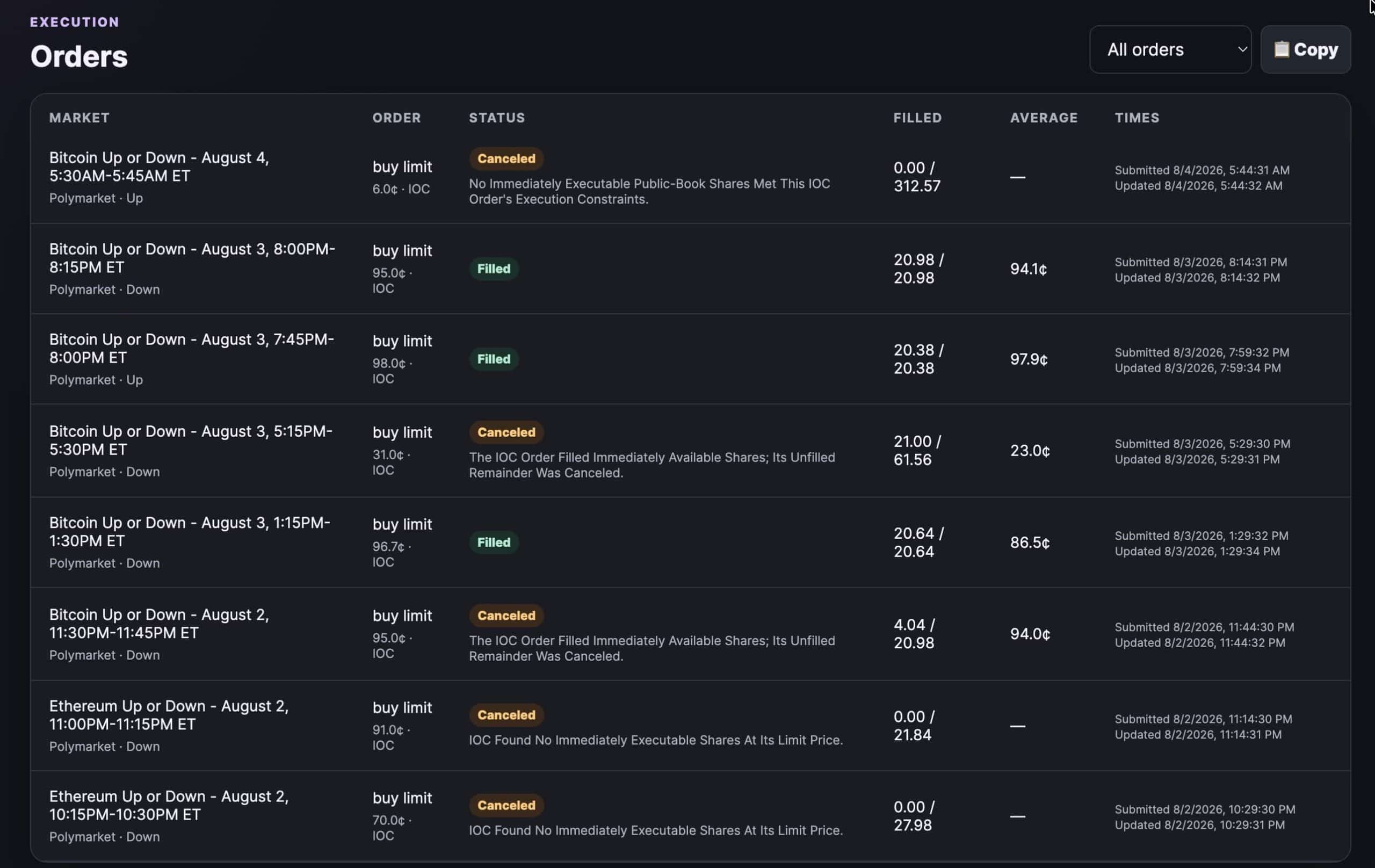
- It is built for inspection, not vibes. The app tracks virtual wallets, orders, positions, fills, fees, and settlement activity so you can look at the actual story after a trade rather than just remembering the wins.
- It has a proper API. You can build against it instead of being limited to a dashboard.
- It is agent-friendly. PaperTiger exposes hosted MCP tools for market discovery, account orientation, paper-order workflows, and research. That makes it a useful sandbox for people building AI agents without letting those agents wander into real-money execution.
How to use it
The normal workflow is the expected: create an account, make a paper wallet, find a Polymarket or Kalshi market, and make a simulated trade. You can start with a simple question like “Do I actually have a useful view here?” rather than an elaborate theory about outsmarting the world, and see how it goes.
For developers and inveterate tinkerers, there is more to play with. The API is documented at papertigerapp.com/docs, and PaperTiger also runs as a hosted MCP service. An MCP-capable assistant can use the same research and simulated-trading surface to inspect wallets, search markets, and work through a paper workflow with you.
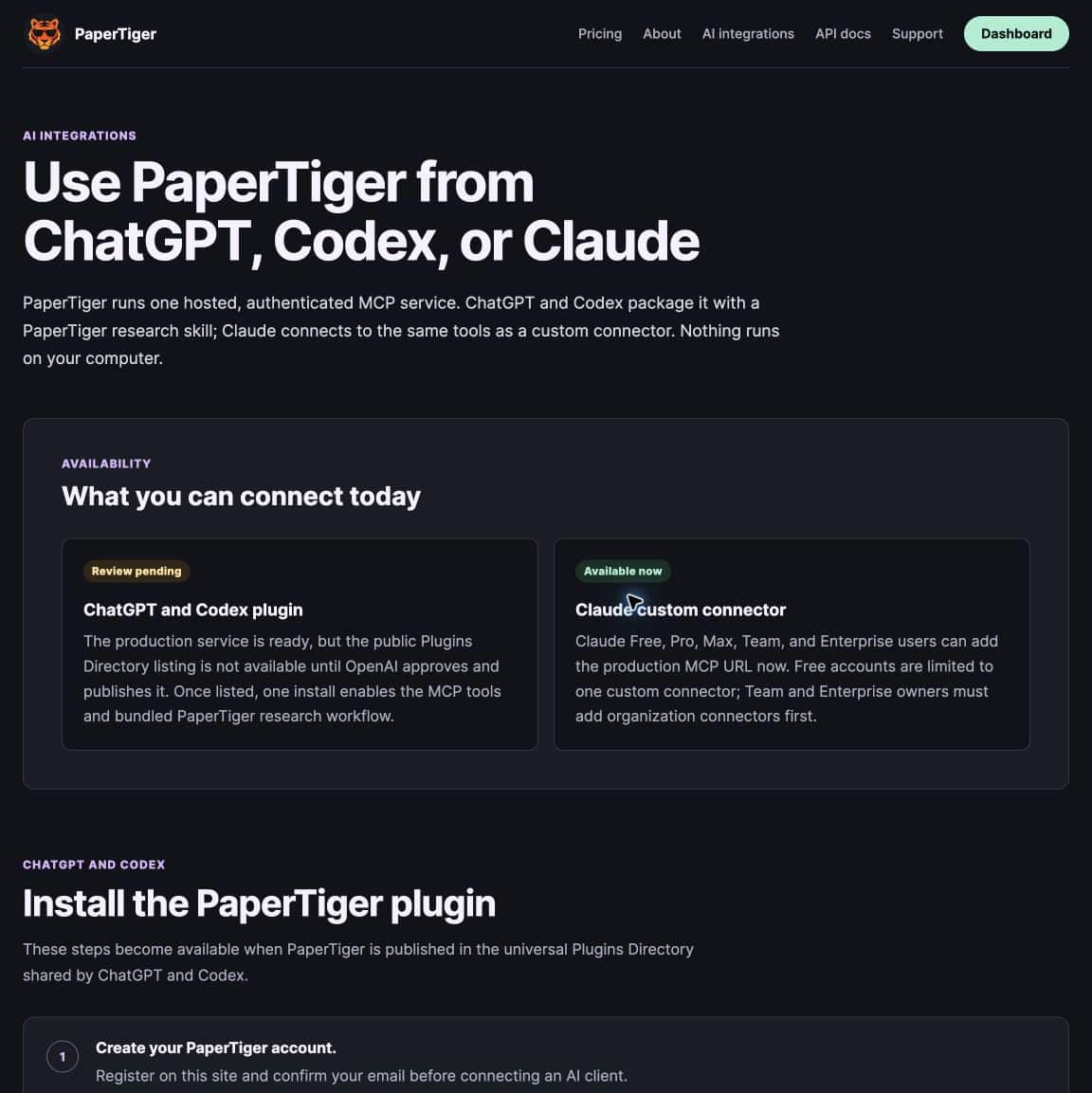
The service already has a hosted, authenticated MCP endpoint. The public ChatGPT/Codex plugin-directory listing is still awaiting OpenAI publication, so I do not want to pretend it is broadly installable there yet. Once it is listed, the intended experience is straightforward: install PaperTiger in a supported ChatGPT or Codex Plugins surface, connect your PaperTiger account, and ask it to help you explore markets or manage a simulated research workflow. Claude users can add the hosted connector today; the AI integrations guide has the current details.
This all means you can let AI trade for you in a safe environment. Ask one to find a market, explain the setup, propose a paper trade, keep records separate by strategy, and then explain why a result happened. You remain responsible for the prompts and decisions; the tool keeps the experiment contained.
What is coming next
Backtesting is the big future feature. I want it to be useful rather than decorative: a way to examine a strategy against historical data with clear limits and honest treatment of incomplete coverage, not a machine that produces flattering charts on demand.
The hard part of this is just collecting the data costs about $200 a month. So I want to be sure of demand, in paid users, before I even start doing that.
So the launch focus is on doing the forward, simulated part well first.
Have a look
If you are curious about prediction markets, want to get better at separating an idea from a result, or are building an AI agent and want a safe place for it to operate, give PaperTiger a try. Sign up here, create a wallet, and see whether your brilliant market intuition survives contact with a ledger.
PaperTiger is for educational and research use. It does not involve live money, does not execute real-money trades, and is not financial or gambling advice.