Finally, I’ve released my dream flashcards app
I’ve done it!
If you know anything about me, you’ll know that I’ve learned a #&$*-ton of languages, relatively speaking. I started with Spanish when I was 20 (“Why do all these Americans know some Spanish?” I wondered, when I didn’t even know “hola”) and worked my way through Italian, Chinese (Mandarin), Korean, Egyptian Arabic, and even Swahili. OK, I’m not fluent in all of those last ones. But I used to be pretty good, and I could get good again.
I love learning languages. It connects me with other people and other parts of the world. It also teaches me about my own culture and language. Even learning Swahili taught me bits about English, like how “hissy” English can sound, and how grateful I am that I don’t have to think about a noun class system when I speak it.
Language study is also meditative, and just fun. That’s why I keep doing it.
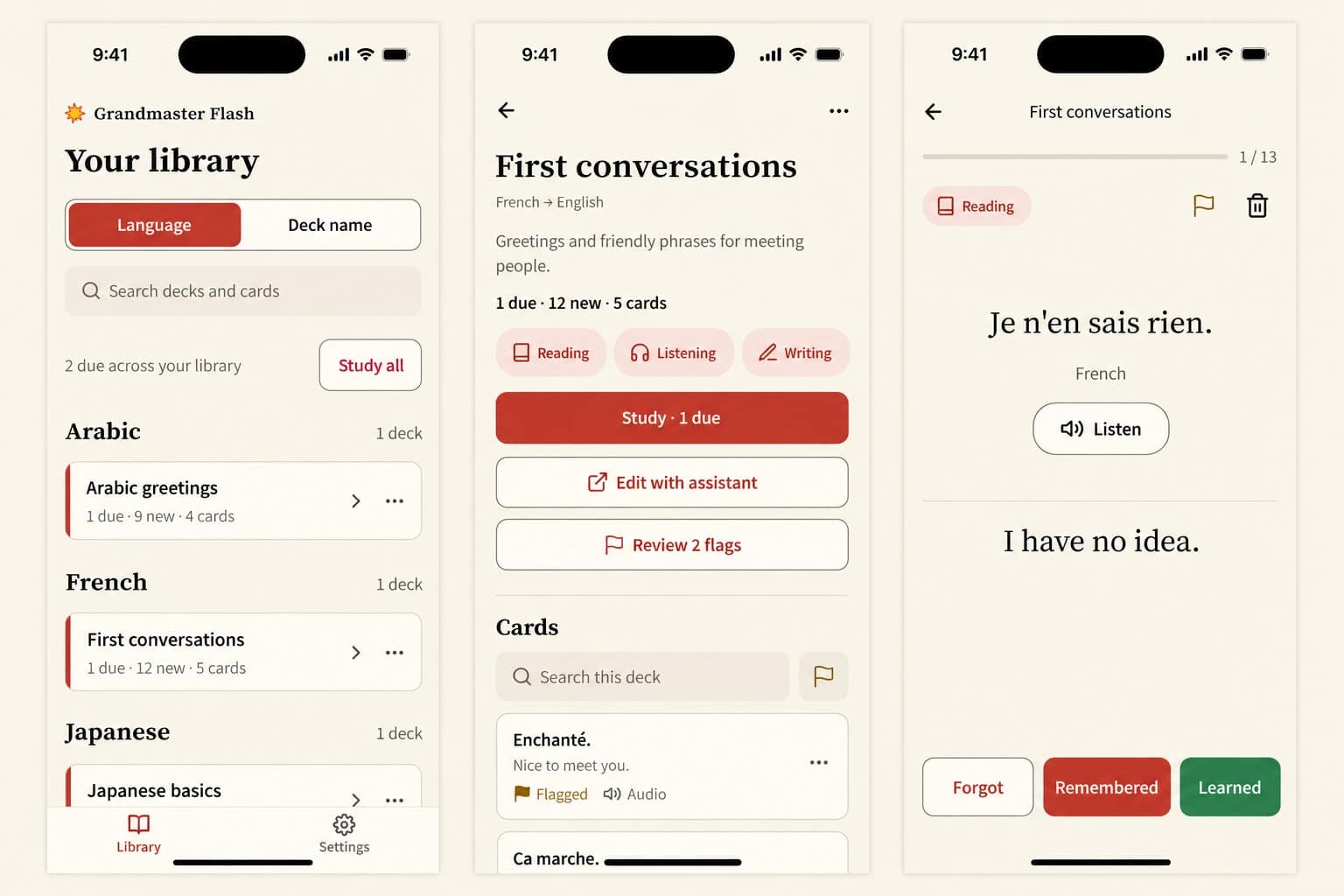
And now I’ve released Grandmaster Flash, the flashcards app I’ve wanted for years. You can download it on the App Store or read more at grandmasterflash.app. It’s on iPhone and iPad; the Android version is in progress.
I mention all the language learning because I built this for myself. I know the pleasure of finally understanding a conversation, and the annoyance of spending my study time fiddling with a spreadsheet. I made the app with love, and I want to share it.
I like studying. I hate making flashcards.
Over the decades, I’ve refined the way I learn languages. Like many people, I think spaced repetition with flashcards is a key part of it. You try to recall something, check the answer, and see it again at an interval that depends on how well you remembered it.
But making the cards has always been a pain. Lately, my process has looked something like this:
- Figure out which words and phrases I need.
- Make sentences with them in English and the language I’m learning.
- Export everything to CSV.
- Import it into a flashcards app.
- Make the audio and get it onto the right cards.
And then study.
Sure, making flashcards is a kind of study in itself. Choosing a word and writing a sentence helps it stick. But sorting out columns, imports, and audio files is tedious and fiddly. Sometimes there’s nowhere quiet to record. Sometimes I pay for an AI audio generator and it gets the pronunciation wrong anyway.
I wanted to go straight from “I need to learn this” to a deck I could actually study.
From ChatGPT or Claude –> a deck on your phone
Grandmaster Flash connects your assistant to your flashcard library. You tell ChatGPT or Claude what you want to learn. The assistant can research the vocabulary, write translations and example sentences, generate audio, and save the cards straight into your account.
For example, you can ask:
Using Grandmaster Flash, make a French deck for ordering at a café in Paris. Include greetings, ordering drinks and pastries, and asking for the bill. Add English translations and an example sentence for each card. Use a male Parisian voice for the audio.
Or, if you’re working on a particular dialect:
Using Grandmaster Flash, create a Spanish deck for business meetings in Buenos Aires. Include introductions, agreeing and disagreeing politely, and scheduling the next meeting. Use expressions people actually say in Argentina, and an Argentinian female voice.
You can also bring material you’re already reading. Attach a screenshot of an article and tell the assistant your level, then ask it to pick out unfamiliar words and use the article’s sentences as examples. You decide what belongs in the deck and ask for changes in the same chat.
Then open Grandmaster Flash and sync. Your cards and audio download to your phone, ready to study.
The phone app handles the practice. You think of the answer, reveal it, and choose Remembered or Forgot. Cards you miss come back sooner; cards you know come back less often. Reading, listening, writing, and speaking have separate practice schedules, so recognising a word doesn’t automatically mean you can say it. You assess your own writing and speaking.
Once you’ve downloaded your decks and audio, you can study offline. Your reviews sync when you reconnect. If a card needs fixing, flag it and ask your assistant to correct it.
I’ve used a similar approach with DiscoHQ, which connects my assistant to my blogs. With Grandmaster Flash, the thing I wanted to stop carrying between apps was vocabulary.
There’s a little setup, once
You’ll need to connect Grandmaster Flash to your assistant before you make your first deck. Sign in with the same email address in the connector and the phone app, so the cards land in the right account.
You need an assistant account that supports the connection. The connection guide has the current steps for Claude and eligible ChatGPT workspaces. Your assistant provider’s account requirements still apply.
After that, you can ask for a deck in a chat and study it on your phone. You create and edit the content through the assistant.
AI can still get translations or pronunciation wrong. I check phrases I’m unsure about with a teacher or someone who speaks the language. If something sounds off, you can ask the assistant to change the card or regenerate its audio.
What’s free, and what paying gets you
I wanted the free version to be enough to study with properly. Flash Free has unlimited decks and text cards, offline study, and sync. You also get a one-time allowance of 6,000 characters of generated audio and 100 MB of audio storage.
That’s a starting allowance for making audio, rather than a timer on how long you can study. Replaying audio you already have doesn’t spend more characters.
Flash Plus gives you 18,000 characters of generated audio each month and 1 GB of audio storage. You can subscribe monthly or annually through the App Store. Check Settings → Plan & usage in the app for your local price, current allowances, and usage.
Paying helps cover the ongoing cost of generating and storing audio, and supports me keeping the app running. If you cancel, your cards and existing audio stay, and you can keep studying. Unused monthly audio characters don’t roll over.
Flashcards are part of the work
Flashcards aren’t the be-all and end-all of learning a language. I’d put them at maybe 30% of my study habits. That’s my rough way of thinking about it, rather than a scientific prescription. I still need to listen to people and have actual conversations.
But flashcards work for me. They help me keep the words I’ve gone to the trouble of learning, and I’ve made getting those words onto my phone a lot easier.
If you like learning languages and keep putting off making your next deck, give Grandmaster Flash a try. Pick something you want to talk about, make a small deck, and see how you get on.