Why They’re Called Potato Scallops
Recently I came across this post on delicious.com.au about potato scallops in Victoria, and was embarrassed to see comment after comment insisting Melburnians call them “potato cakes” because “scallops are seafood”.
Yes, Victorians generally call them potato cakes. I live in Melbourne. I know. What got me was the confidence that the word scallop couldn’t possibly mean anything else.
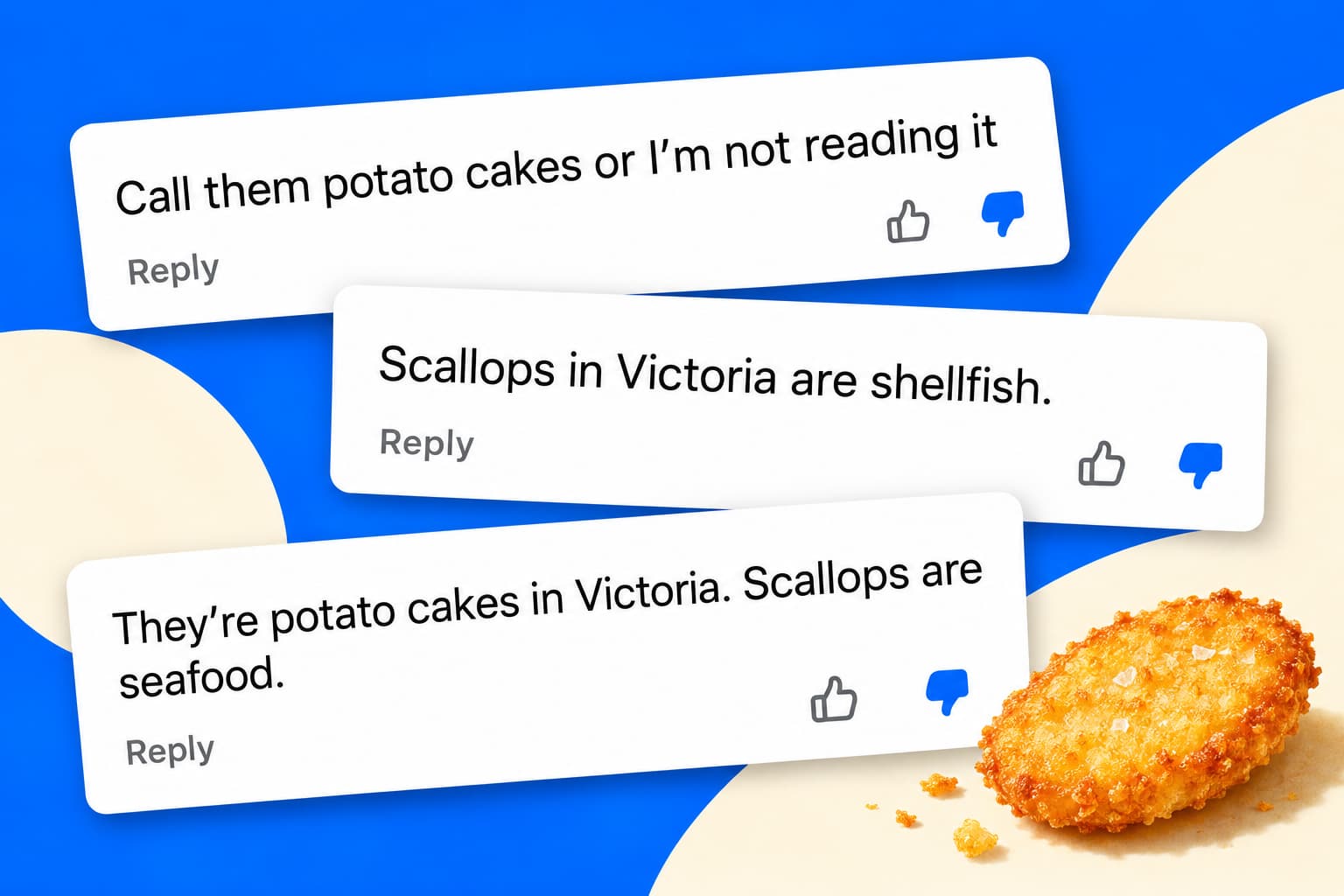
Call them potato cakes or I’m not reading it
Scallops in Victoria are shellfish.
They’re potato cakes in Victoria. Scallops are seafood.
Those are exact comments from the screenshots I took of delicious. Australia’s Facebook thread. I’ve left out the names because the argument is the interesting bit. There were plenty more like them.
It’s embarrassing because Melburnians on the one hand love claiming to have Australia’s most European city, and on the other apparently find a French culinary word beyond comprehension. We can discuss the authenticity of an Italian restaurant for half an hour, but a potato with an unfamiliar name brings the whole operation down.
A scallop can be a thin slice
In French, an escalope is a thin slice of meat. In Italian, the related word is scaloppina, plural scaloppine; you might have seen it written as “scaloppini” on an English-language menu. Think veal with lemon or marsala. Nobody expects a shellfish to turn up.
English has this culinary meaning too. The American Heritage Dictionary’s entry for “scallop” includes a reference to escalope, as well as the verb meaning to cut meat into thin, boneless slices. It’s right there, below the molluscs and the decorative edges.
A potato scallop is a thin slice of potato, battered and fried. The familiar explanation of the name connects it with escalope, the thin-slice culinary term. Triple j was discussing that explanation back in 2018. You don’t have to agree with a breakfast radio host to notice that “scallop” has more than one meaning.
Jesus Christ, Facebook commenters, learn French or Italian. It’s not even that hard. They have the same letters and enough familiar words to get you started. You can at least make it as far as the menu.
But if you can’t be stuffed, at least learn the etymology of what you claim is your native language. Or Google it! Or use ChatGPT! I don’t care! Check the answer before giving everyone else a spelling lesson.
The etymology needs one small qualification
Since I’m telling people to check things, here’s the detail I have to get right, too: English “scallop” wasn’t borrowed from Italian “scaloppini”. Treccani traces Italian scaloppa to French escalope; scaloppina is its diminutive.
And the older history involves shells. American Heritage traces English scallop to Old French escalope, meaning a shell. So the seafood and the culinary slice aren’t two wholly unrelated words that happen to sound alike. The family history is more complicated than “French for a slice”, and I wouldn’t pretend a modern dictionary proves exactly who first named the Australian takeaway snack.
None of that rescues “scallops are seafood” as an argument. A word can acquire another meaning. This is a fairly basic feature of language. A mouse can operate a computer. A bat can hit a ball. A cake can be made of potato without icing or birthday candles.
You can still call them potato cakes
I’m not asking anyone to march into a Melbourne fish and chip shop and demand a change to the menu. Call them potato cakes. Call them potato fritters. Order three and hope they put a fourth in the bag.
“We call them potato cakes here” is a perfectly sensible observation about local usage. “They can’t be called scallops because scallops are seafood” is a claim about what a word means, and it’s wrong.
The delicious article currently uses “potato cakes” in its headline and body, incidentally. My complaint is about the reasoning in the Facebook comments, not whether the writer knows which state she’s in.
I have similar feelings about people who discover one punctuation mark and start policing everybody else’s writing. Learning one use of a word doesn’t make you the custodian of all its other uses.
You can be proud of Melbourne without treating a fish and chip order as a citizenship test. And if we’re going to keep calling ourselves European, we could occasionally open a dictionary from Europe.
Preferably before opening Facebook.