
The CEO’s Margin of Error — A Story
One thing I remember from the blurry haze that was my time “dancing the electric slide” at Bain in the early 2000s was a mini-presentation to the juniors by one of the partners who told us what it was like being a CEO.
Being a young whippersnapper, I lapped this stuff up. Unlike some of my well-connected colleagues, I didn’t meet many CEOs. I was fascinated by the idea of seeing one up close.
The partner in question had been CEO of a couple of mid-tier listed companies in Australia. “Australia?” you cry. “Get real.” Whatever, these were companies with valuations in the hundreds of millions of dollary-doos. They had hundreds (or thousands? I don’t know) of employees. That’s spicy enough for me!
Anyway, what he told us stuck with me, and applies strongly to what I’m doing these days (algo trading), so I’m writing it down for posterity.
A CEO’s Responsibilities to Predict the Future
The first thing he explained was that the CEO’s job was to be a central source of information, managing expectations and reality across several competing sources of pressure. Let’s see if I can remember them all and create a diagram…

Wow, that’s a lot of stakeholders! I do hate the word “stakeholder”, but in this case, it’s easier to say than “affected parties”, which also sounds stuffy. Anyway, all these people hold stakes, and are trying to drive them through the CEO’s spleen.
What do all these stake-wielding jerks want? They want to know what’s going on. Shareholders want to know if the stock will go up. The media wants its pound of flesh. Employees just want to know if they can show up tomorrow.
So part of the CEO’s job is to form a reasonably accurate view of what may happen in the near future, and to keep stakeholders informed and reassured.

That’d be nice, right? We all want to know the future. Well, it’s bloody hard, and that’s one reason why CEOs are paid well when they do a good job, I suppose (not that I disagree that they’re often overcompensated).
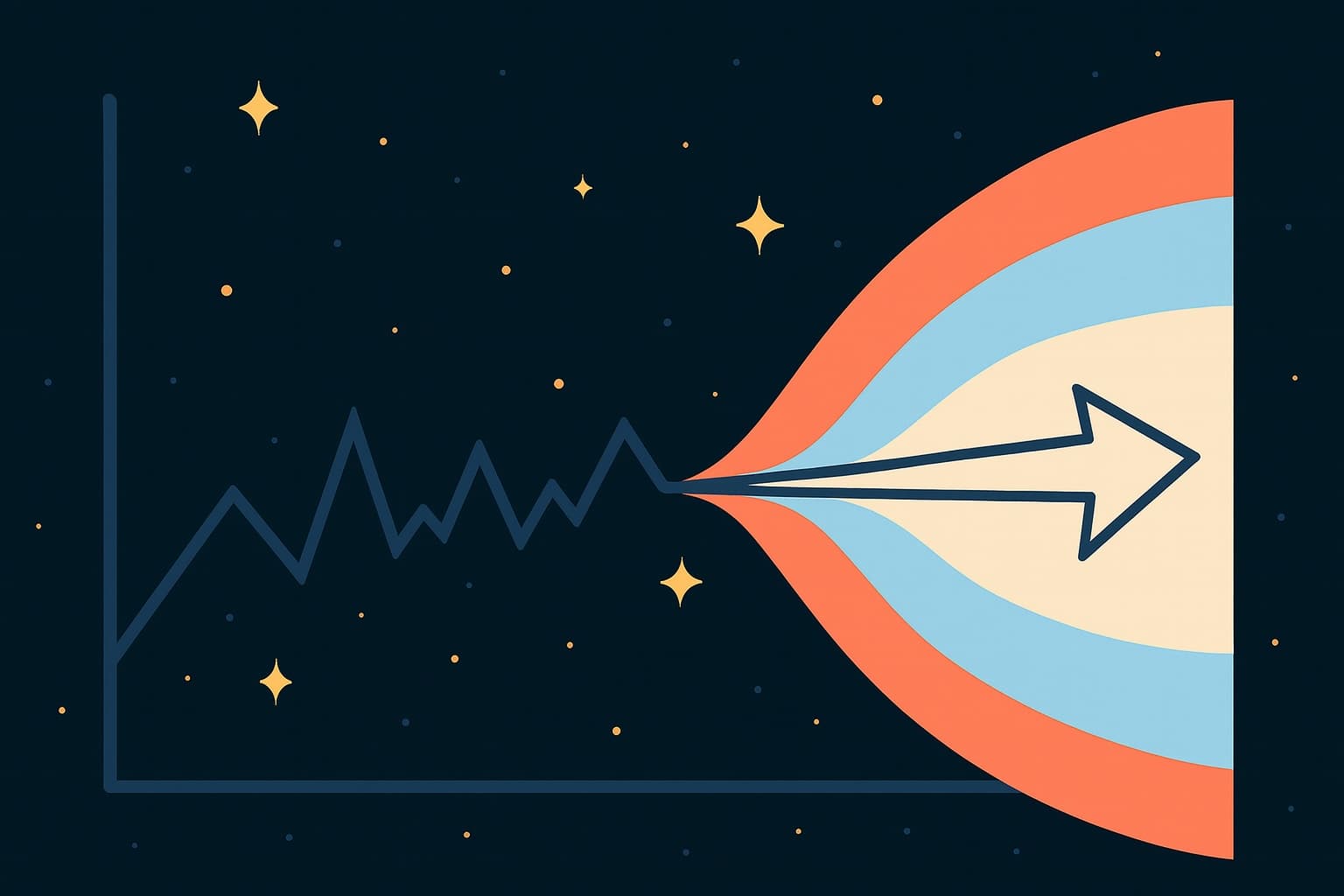
But the most interesting part is that he explained that when predicting the future, you have to be within the margin of error both ways, whether things are going well or badly.
In other words, if performance is worse than you predicted, that’s obviously bad. If it is significantly better, that can also be a warning sign in some contexts, because it may mean your model or guidance was not well calibrated.
Applications to Trading
This hits home because in algorithmic trading (my current shindig), you always have a caveat of “past performance is not an indicator of future performance”.
In its simplest terms, this means that just because a stock went up, you can’t assume it will keep going up. Everyone knows that, and it’s generally true, although there are exceptions over some periods and in some contexts. (E.g. the stock market has generally gone up consistently over the last 100 years, but there have been lots of scary periods in the middle.)
But a more nuanced view, applied to an algorithm, is “just because your algorithm worked on 10 years of past data, you can’t assume it’ll continue to work in the future”.
In other words, if I say “buy when RSI < 30, sell when it’s over 70”, if that happened to work over the last two years, it might not work next month. Or ever again.
It’s satisfying when it DOES work, though. Here are a couple of strategies that are behaving roughly in line with what I thought.

The first one is alarming a bit. A win rate of 100%! Of course, it has only done two trades, so we need more data.
But then, that second one, with its return of 0.18% versus an expected 0.19% and a win rate of 60% versus an expected 56.3%… that is sweet.
How much longer will these be valid? I don’t know yet… once I have more data, I’ll have to add procedures to decide if an algorithm is still valid or if it needs to be rebuilt.
What’s the right margin of error?
This is something that all traders grapple with. How many times does a strategy have to fail before it’s deemed non-functional? That’s a whole other question of statistical analysis.
You need two things:
- A statistically significant sample considering the parameters of the prediction
- Defined parameters that mean your prediction is either out of bounds or within bounds
As a starting point, I’m considering a tolerance of about one-quarter of a standard deviation, but the sample size needed for a 95% confidence interval will depend on the strategy’s variance, effect size, and trade frequency. But I can vary that later…