
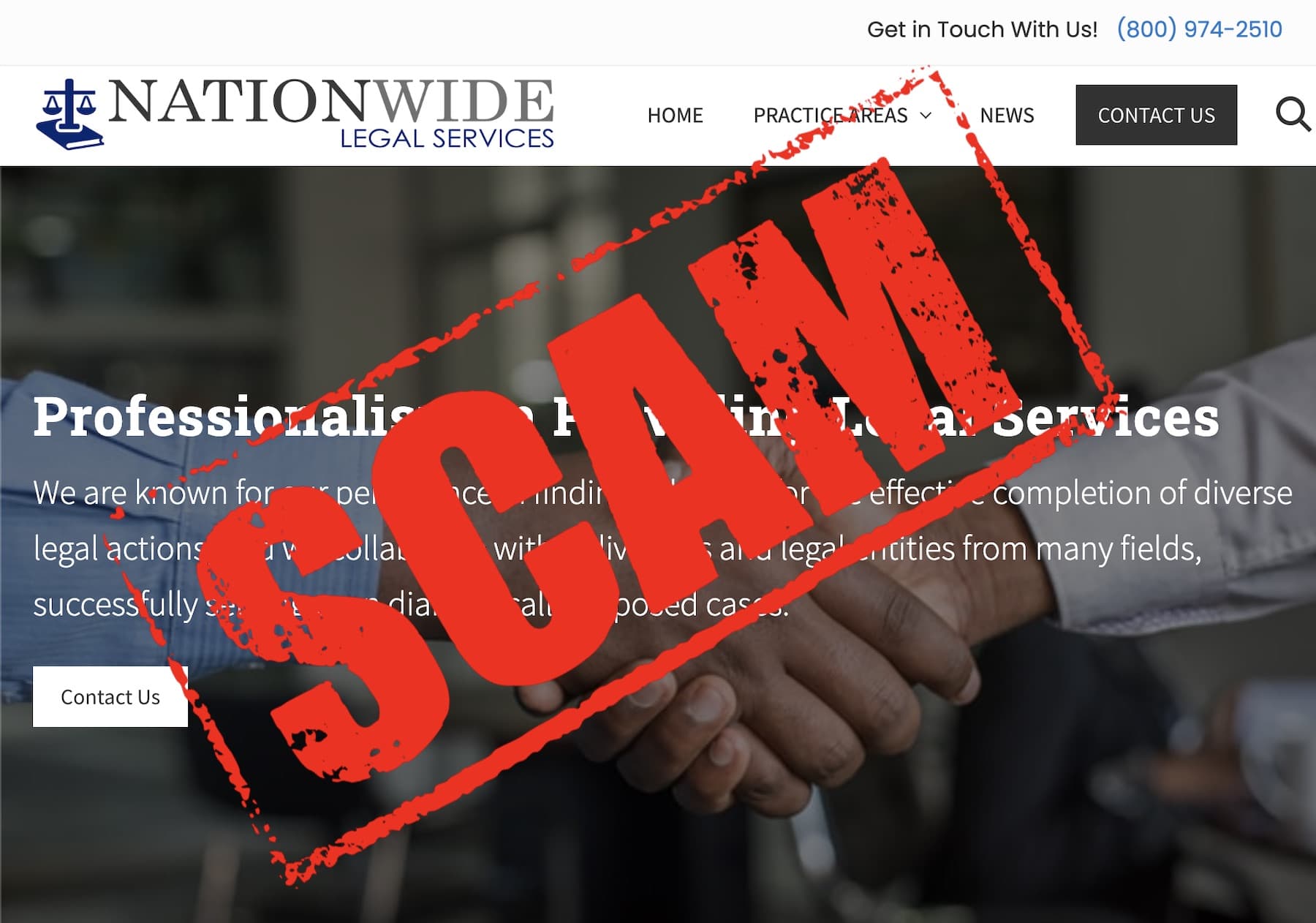
Fake DMCA Copyright Infringement Scams
I’ve recently become aware of a new kind of scam / phishing attack: the DMCA Copyright Infringement scam.
A DMCA infringement notice is a notification that you receive when some authority realises that you’re illegally using copyrighted information. They ask you to take it down.
I’ve only ever seen one legitimate DMCA notice in real life, when my roommate was illegally downloading episodes of something via a torrent.
While I’ve never received a DMCA notice for any content on my websites, I’ve definitely received my share of DMCA infringement scam attempts.
Update: Received another one in 2025, so adding that to the list!
What Fake DMCA Notice Scams Look Like
Generally speaking, a DMCA infringement scam attempt works like this:
1. Someone will write to you from one of the following scam websites:
- Nationwide Legal (Nationlaw.us, previously Nationlaw.org which was taken down, prior to that nationwidelaw.org but taken down, also previously nationwide-law.org, also taken down)
- Arthur Davidson Legal (arthurdavidson.com, also taken down)
- Taylor Wilson Smith Legal Services (www.taylorwilsonsmith.com), also taken down)
- Citi Legal Services (citi-law.org) — a new one for me from 2024!, now taken down as of 2025
- Commonwealth Legal Services (www.cwadvisors.biz), a new one for 2025
- Others, too, probably down by now.
2. They claim that you’ve used a copyrighted image, sending you a link to an imgur file rather than showing what’s on your website.
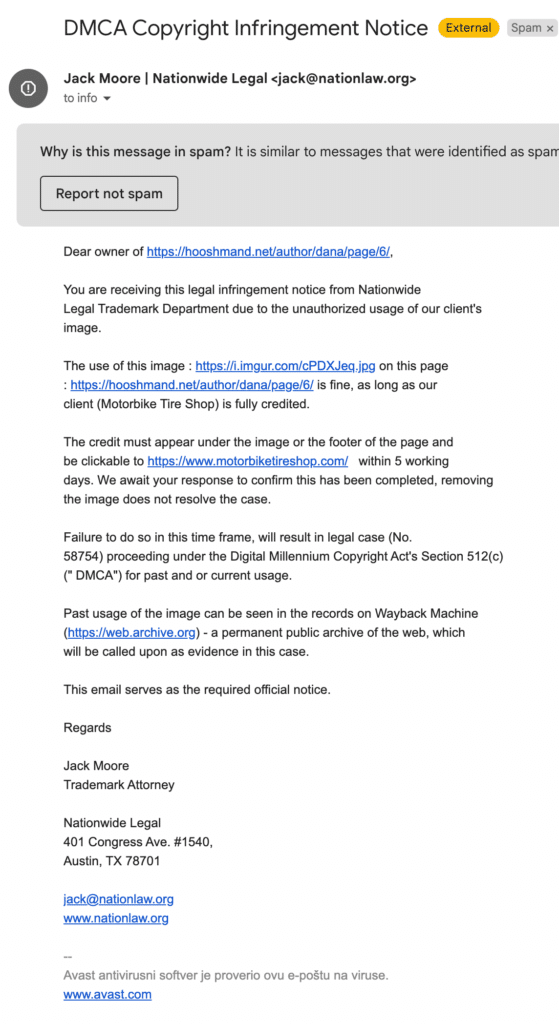
It’ll look something like this (this is copy-pasted from the email I received):
Dear owner of https://hooshmand.net/author/dana/page/6/,
You are receiving this legal infringement notice from Nationwide Legal Trademark Department due to the unauthorized usage of our client’s image.
The use of this image: https://i.imgur.com/abcdef.jpg on this page is fine, as long as our client (Motorbike Tire Shop) is fully credited.
3. As you can see above, they don’t ask you to take it down (it’s not even an option!), but to credit a random website that they say is the originator of this image.
The entire thing is done automatically. This is obvious because look at the content of the latest one I received (also similar to the previous one)
Here’s the full letter, screenshotted.
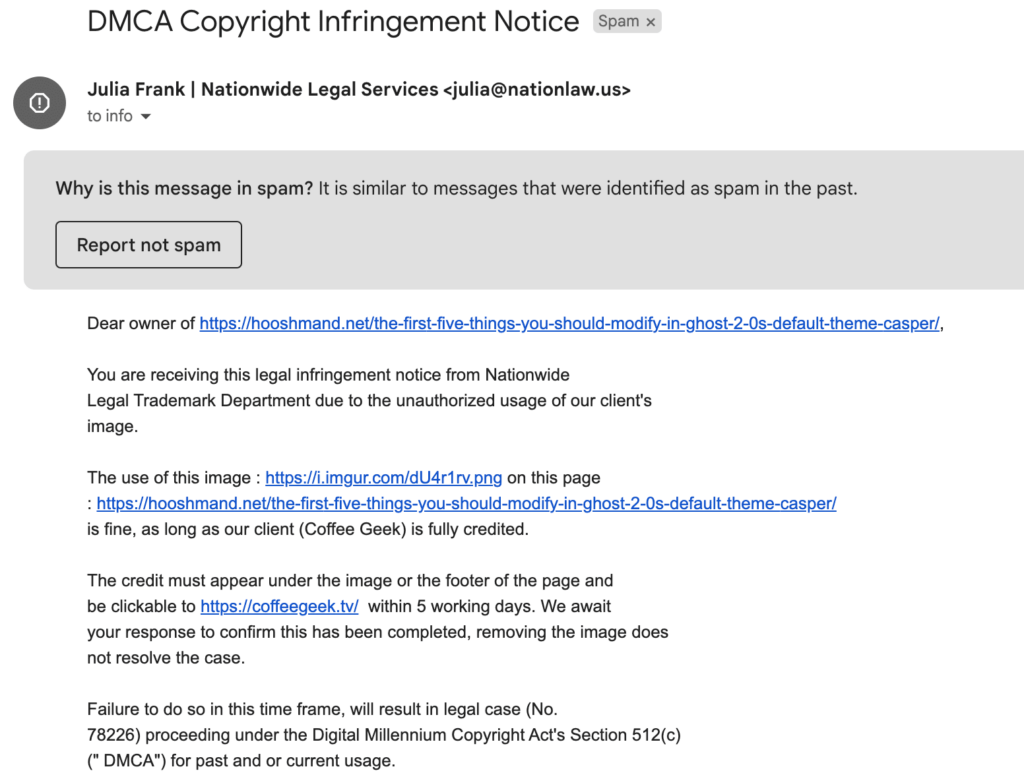
Here’s another one, for coffeegeek.tv. Again, I wonder if they know they’re using the scummiest of backlink agencies.
This one’s from nationlaw.us, a new domain with a website that looks exactly the same as the old ones on the old domains.
And they keep iterating on that domain! Here’s one from another iteration of the fake law firm, nation-law.site (not even a good domain! What kind of crappy law firm has a “.site” domain…)
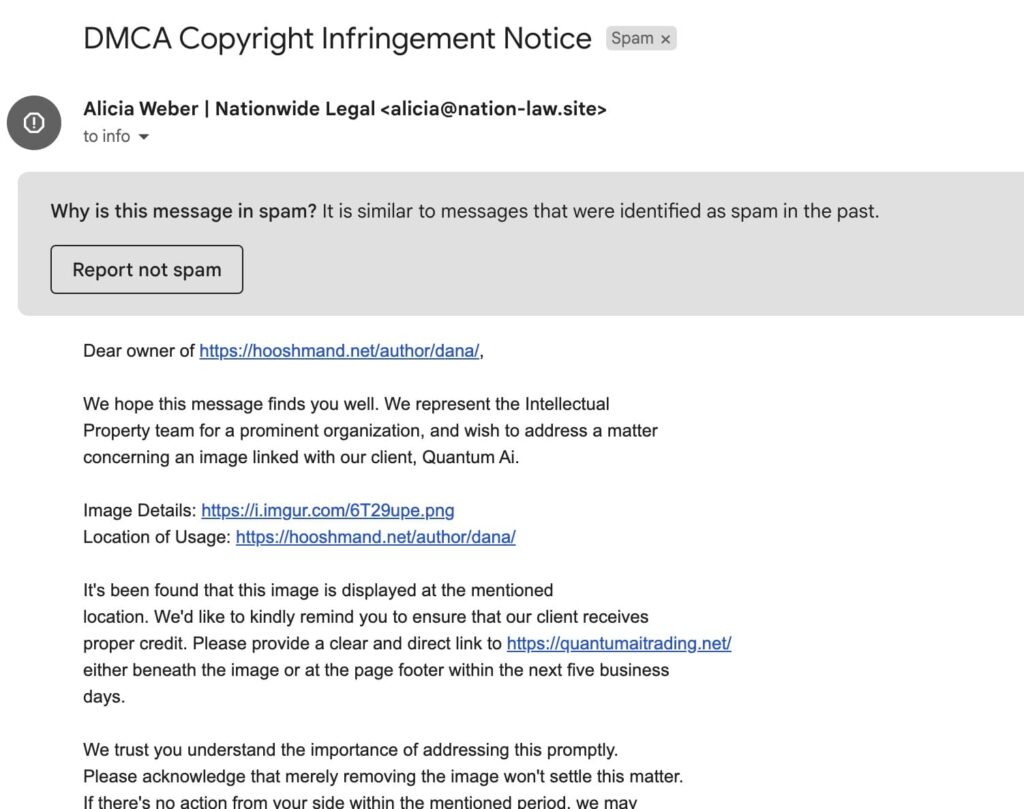
Looks like they improved several aspects of the scam email in this version. I’ll address these below.
Obvious Signs of a DMCA Notice Scam
There are many fairly obvious signs of a scam using a DMCA notification, but the most obvious ones to me are the request for a link and the use of intimidating-sounding legalese.
If you’ve ever had the misfortune of having to read a legal document, you’ve probably noticed that they look quite different to this. They don’t make arbitrary requests, and they don’t make vague threats.
The reason they make these threats, of course, is to intimidate you. You think “Argh! I’ve done something bad,” then comply out of fear.
The purpose of this scam is to generate backlinks for that website. The people doing this aren’t lawyers; they’re black hat SEOs.
Just in case, I even checked the image and couldn’t find it anywhere on that page (or on my website).
One interesting thing I noticed in the most recent one is that they request a link as the only form of compensation.
We are emailing you to insist our client is correctly credited. A
visible link to https://www.ruggedmotorbikejeans.com/blogs/motoblog is
necessary, placed either below the image or in the page’s footer. Kindly
understand that simply removing the image does not rectify the issue.
Et tu, “ruggedmotorbikejeans.com”? Lame backlink scam. Be better; hire proper agencies.
Looking Deeper into the DMCA Notification Scam — More Red Flags
There are other obvious red flags, aside from the general nature of the content.
- The link they’ve mentioned on my site is one of the miscellaneous author pages, not a blog post.
- Someone from the “Trademark” department is writing about a DMCA notification, which regards copyright. (They’re different areas of intellectual property law.)
- There are obvious typos in the document, like unnecessary spaces or poor syntax. Law firms don’t often make typos. I’d say they rarely make typos.
- The email mentions a random case number, probably to make it sound legitimate.
- The image itself may not even exist on your site, let alone the page from which they want a backlink.
- The antivirus notification in the footer is in Croatian. (They’ve updated this, in recent emails).
Is Nationwide Legal a Real Law Firm?
It’s fairly obvious that Nationwide Legal is not a real firm. Here are a few points of proof.
Firstly, as mentioned above, the URL frequently changes as old versions are taken down.
Secondly, the staff don’t seem to exist.
“Jack Moore”, the person in the first claim I received, does not exist anywhere but on the company’s website. No LinkedIn, no other publications, no references to universities… it’s probably an AI-generated image (like from “This Person Does Not Exist” or generated.photo). This has been happening for years – well before AI image generation became a mainstream tool.
The same is true of “Alicia Weber”. Googling that name and “Lawyer” just shows other posts like this one about fake DMCA claims.
Finally, the websites have no authority or history. The website for Nationwide Legal looks legitimate, at first blush. They’re using the old name from before they had to change to the new domain, several times. The website is the same.

But look up the history of this website with any service — including archive.org, the website they themselves claim to use — and you’ll see that it has no history, no links, and no traffic.
For example, see the data below from moz.com’s free domain analysis tool.
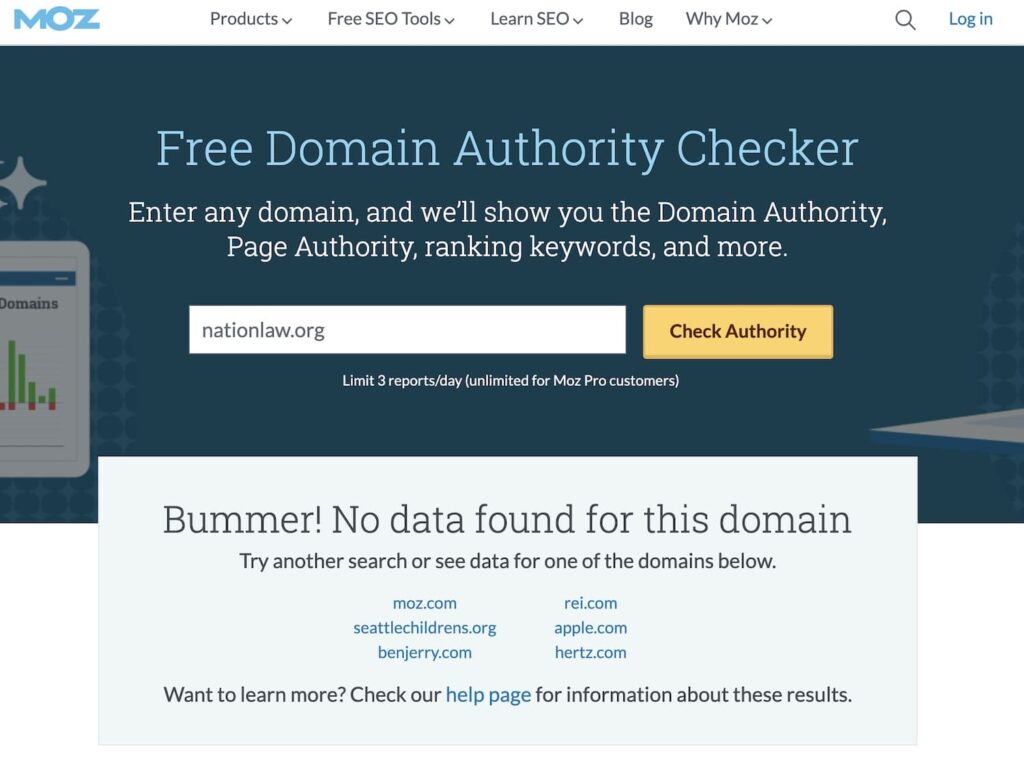
There’s data for even the smallest websites I have which get just half a dozen pageviews a day.
So wow, “Motorbike Tire Shop”, “Coffeegeek.tv”, and “Rugged motorbike jeans”, You’ve got a pretty sleazy SEO working for you. Consider paying more, next time. If you’re intentionally going black hat… that’s sad.
Actual Requirements of a DMCA Notification
If you know what a DMCA notification needs to look like, it gets worse.
Have a look here, the official DMCA website. A DMCA takedown notification should, at minimum, contain (some of these are suggestions, but they’re obvious and commonly used ones)
- A signature of the owner or of the person authorized to act on behalf of the owner of the copyright interest,
- Identification of the copyrighted work the claimant is claiming has been infringed,
- A description of the material that you claim is infringed, and the location where the original or an authorized copy of the copyrighted work exists (for example, the URL of the page of the website where it is lawfully posted)
- A clear description of where the infringing material is located on the website including (as applicable) its URL so the claimed infringed material can be located,
- Name, address, telephone number, email address,
- A statement that you have a good-faith belief that the disputed use is not authorized by the copyright owner, and
- A statement by you, made under penalty of perjury, that the above information in your notice is accurate and that you are the copyright owner or authorized to act on the copyright owner’s behalf.
The above letters lack most of these things. There’s no description of where the original content is, there’s no signature, there’s no statement of good-faith belief or that the information in the notice is accurate, and so on.
What to do?
If you receive a real DMCA infringement notice, heed it. Delete the content, and use content that isn’t protected by copyright.
But if you receive a fake DMCA notice, like one from nationlaw.org or one of its aliases – by all means, ignore it.






really thank you for this post, so important to me!!!
You’re welcome! Glad to help.
Thank you so much! I just found one of these in my spam box. And, indeed, the image does not exist on my site!
Thank you so much! 😀
Hi,
I publish a newsletter and received the same thing but, in my case, the request was to credit a well-known and supposedly legitimate sneaker reseller. It seems the site must be complicit in the scam – I can’t think of any other reason. Interested to hear your thoughts on this?
I think either tacitly so – paying a vendor who does dodgy things – or maybe victim of a smear campaign. But yes. The websites I was asked to link to were established businesses.
This is especially concerning given the recent precedents established by Sony v. Cox. In that case Sony was awarded $1 Billion in damages because Cox failed to terminate internet service for persons who received DMCA notices. While an appeals court vacated the amount, they reaffirmed that the ISP was liable for some damages. Of particular concern is the fact that since absolutely anyone can send a DMCA notice it implies that an ISP or web host essentially has to terminate service permanently for anyone who is sent multiple DMCA notices without regard to if they are real or not.
I was already aware that some companies would abuse DMCA to claim that a particular IP address pirated content when in reality no such action occurred so that they can send extortion letters. For example, I’d occasionally get a letter asking me to pay $500 for an alleged violation. Those stupid enough to pay it immediately get several more letters claiming that each new date is a new violation. They never substantiate the claims. In theory it should be possible to create fake evidence by having a torrent system running on a local intranet where you can create any IP address you want to therefore get a real screenshot, but in practice they don’t really want to sue. They just cast a wide net to profit from the violations. They also rely on the idea that the customer could be held responsible even if someone else uses their WiFi to further create the idea of responsibility (a parent might just assume their child downloaded whatever was alleged and pay it) and some of these companies might actually have a contract with the company while others are just pretending to be that company and there is really no way for anyone to know.
That said, this is a variant I didn’t know about so I really appreciate being informed. In my case, any DMCA notice would go to the web host instead of me and I have previously had websites break because content gets moved to a DMCA folder so now I wonder if this is the reason why.
Wow, that’s really insidious – fake notices + fines! I hadn’t come across that and thanks for telling me.
I did once receive a real DMCA notice when a roommate was using a torrent client mistakenly without a VPN. But we just stopped doing that and the world moved on. That is my understanding of how things really work.
Bookmarked your article some time ago after receiving a Nationwide fake email. Got a Citi Legal one today so was delighted to see you’d added those as another scammer. Usual style, no image on the article they claim, imgur link and demand for Backlinks (no links clicked obviously). I’m in the U.K. so they’re scamming over here too. Stay safe everyone.
Thank you so much for keeping the awareness active.
Blessings
Glad it was helpful. They’re annoyingly scary, aren’t they, even though we know better!