Launching Crossbench: My Australian Tangle Clone
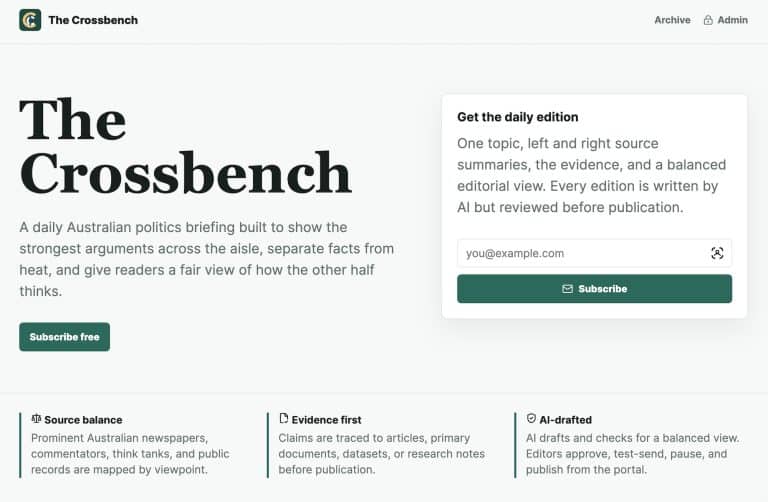
I’m launching Crossbench, which is my attempt at building an Australian version of Tangle.com — except this one is automated, slightly less polished, and hopefully less annoying than the average political inbox you never asked for.
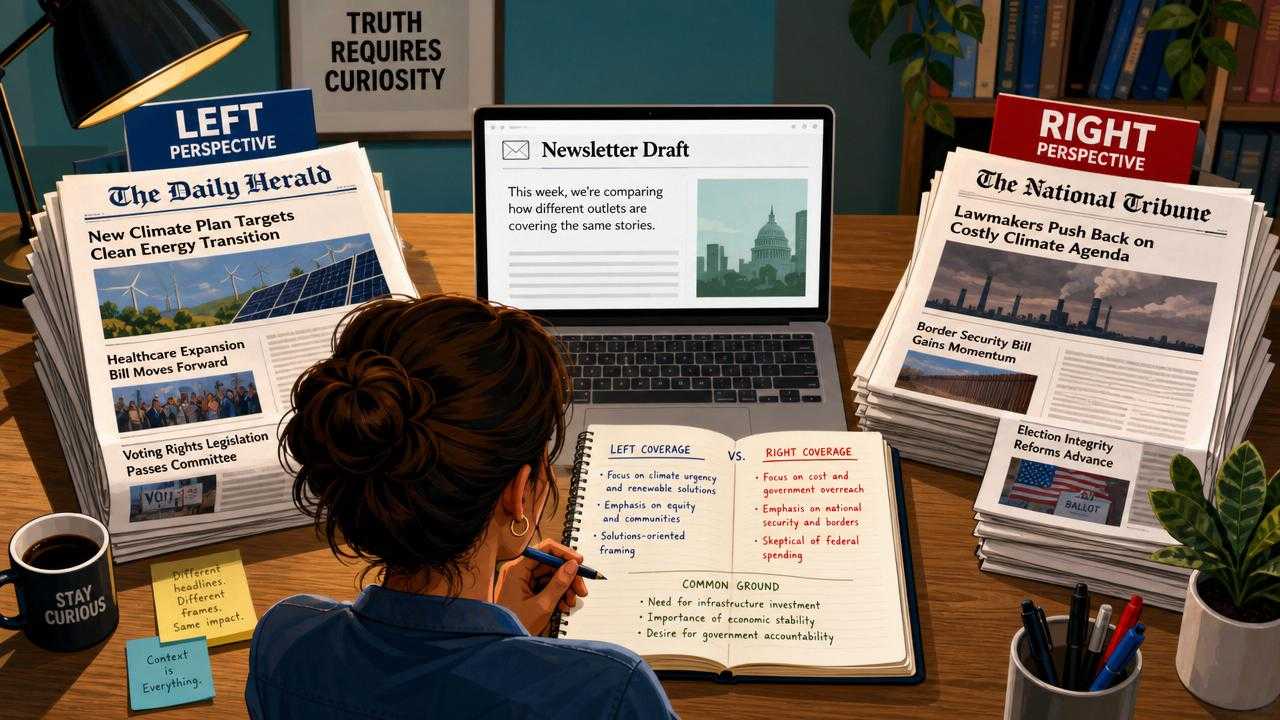
The idea is simple enough to fit on a napkin: pull from left-leaning and right-leaning sources, compare what they’re saying, and write a newsletter that gives people both sides without pretending one of them is made of pure truth dust. Novel concept, I know.
Why I’m doing this
I’ve been inspired by Tangle for a while, and I mean that in the fully open, not-trying-to-hide-it sense. It does a really good job of taking a political topic, pulling apart the arguments, and making room for more than one brain cell in the room.
Australia badly needs more of that energy. We get a lot of loud takes, a lot of lazy summarising, and a lot of people treating nuance like it’s a waste product. So I figured: fine, I’ll build something that at least tries to be fair before it gets loud.
If you’re interested in the bigger AI angle behind this, I wrote more about that shift here: Going All In on AI
What Crossbench does

Crossbench is an automated newsletter that polls left and right news sources, then writes a balanced summary with citations from both sides. That means the reader gets the story, the disagreement, and the actual shape of the argument instead of one side’s press release wearing a fake moustache.
The structure is currently heavily inspired by Tangle. I’m not pretending otherwise. The difference is that I’m building toward a more dynamic research engine over time, so it can stop acting like a neat little imitation and start becoming something that adapts to the topic instead of just following a template around like a loyal dog.
| Part | Current version | What I want next |
|---|---|---|
| Source selection | Left and right outlets are polled manually/automatically | Smarter topic-aware source selection |
| Writing | AI assembles the newsletter draft | Better synthesis and fewer robotic seams |
| Tone | Balanced, direct, citation-heavy | More dynamic formatting and stronger editorial rhythm |
| Business model | Free for now | Potential token price if source costs force the issue |
The uncomfortable part: AI is useful because it lacks a personality
This is the bit people usually get weird about, so I’ll say it plainly: AI doesn’t have the human touch. That is normally a weakness. In this specific case, it might be the whole point.
If the product is supposed to be balanced, then my personal biases should not be the star of the show. The less editorial ego in the way, the better. I’m not trying to build a newsletter that agrees with me. I’m trying to build one that doesn’t care what I think and says the annoying honest thing anyway.
A note on the research engine
Right now, the engine is good enough to launch and bad enough to keep me humble. It can find, compare, and draft. It cannot yet do the magical “know exactly what matters this week in Australian politics” thing that would save me a bunch of headaches and probably several bad moods.
That’s the long-term job: better source selection, better topic framing, better summarisation, and less of the awkward machine-glue feeling that shows up when automation gets ambitious and starts sweating in public.
If you want the more technical side of how I’m handling structured output, this post is the relevant rabbit hole: Using Zod and zodResponseFormat with OpenAI
Money, domains, and the usual glamorous nonsense
For now, Crossbench is free as long as that makes sense. I’d like to keep it that way because free is nice, readers like free, and I enjoy being the sort of person who can say “it’s free” without immediately coughing up a cloud of future invoices.
If paying for news sources becomes a real cost, then I may put a token price on it. Not because I’m suddenly discovering greed, but because the internet has an irritating habit of making useful things expensive once they stop being toys.
It lives at cb.discomedia.co right now. If it gets enough traction, I’ll move it onto its own domain, because every project eventually gets big enough to deserve a proper front door instead of the digital equivalent of a side alley.
What I’m hoping happens next

The ideal version of Crossbench is boring in the best way. It shows up, reads a pile of sources, does the balancing act, and hands over something readable without turning every issue into a gladiator arena. That’s the dream. Pretty modest. Basically just politics without the circus tent.
I also want it to become more flexible over time, because templates are fine until they start becoming a personality disorder. The more the research layer improves, the less the whole thing will feel like “AI fills in the blanks” and the more it can feel like a useful editorial machine that earns its keep.
I’m not trying to build a newsletter that sounds human. I’m trying to build one that sounds fair.
So that’s Crossbench: an Australian, AI-assisted, left-right news balancing project that is part experiment, part opinionated infrastructure, and part me refusing to accept that political news has to be a binary shouting match forever.
It’s live, it’s rough, it’s useful, and it will almost certainly get less embarrassing with time. Which, honestly, is the whole business model for most things on the internet.