All the Epiphone Hollow and Semi-Hollow Bodies
So, you want a hollow body, and think Epiphone would be an affordable gateway drug.
But it’s not as easy as thinking “I want an Epiphone ES-335.” No sir. Once you include discontinued models and reissues, Epiphone has made dozens of hollow and semi-hollow guitars. On the used market, it can be baffling.
A Casino looks a lot like a Sheraton. A Sheraton II looks a lot like a Sheraton, except the pickups and tailpiece may be different. A Riviera might have two mini-humbuckers, two full-sized humbuckers, or three P-90s. All perfectly normal. Apparently.
So I’ve put together this research to help you work out:
- What are the differences between the models?
- Which guitars suit which styles of music, and which cope with loud, overdriven playing?
- Which are the most versatile?
- Which make sense as an affordable first purchase you might later resell?
- What should you check before handing over your money?
Enjoy! Or at least enjoy having fewer tabs open.
I’m concentrating on electric guitars you might actually encounter second-hand, including the main discontinued families and the signatures that change the specification. I’ve grouped colour editions together, and put the acoustic archtops and collector territory near the end. This is a buying guide based on model research, rather than a claim that I’ve played every guitar here.
If you like this sort of guitar rabbit hole, I’ve also collected some weird and wonderful Squiers. I have a weakness for guitars that do something a little different.
First, what’s inside the guitar?
The biggest difference is whether there’s a solid centre block inside the body. The f-holes won’t tell you. Neither will a seller calling everything a “semi-acoustic.”
| Construction | Examples | What it means when you play |
|---|---|---|
| Semi-hollow with a centre block | Dot, ES-335, ES-339, Sheraton, Riviera, Lucille | The block supports the centre of the top and usually the bridge. The hollow sides still resonate, but the guitar generally tolerates amplified volume and distortion better. |
| Fully hollow | Casino, Casino Coupe, Broadway, Joe Pass Emperor II, ES-175, Swingster | No full-length centre block. The body tends to respond more to the sound from your amp, so you need to manage feedback. |
| Chambered small body | Wildkat, Alleykat, Flamekat | A routed wooden body with a separate top and substantial wood remaining inside. These don’t have the same construction as a conventional laminated 335. |
A fully hollow guitar can still have braces, bridge supports and other wood inside. “Fully hollow” doesn’t mean someone emptied it out with a spoon.
Feedback happens when sound from your speaker makes the guitar vibrate, the pickups send that vibration back to the amp, and the loop builds. Gain, volume, where you stand and the particular guitar all affect when it starts. A centre block raises the practical ceiling; it doesn’t make a guitar immune.
Also, feedback and electrical hum are different problems. A Casino’s hollow body contributes to feedback; its P-90 single-coils can pick up mains hum. A hollow jazz guitar with humbuckers can cancel that electrical hum and still howl in front of a loud amp.
Fully hollow guitars can sound great with distortion. But if you want tight high-gain rhythm playing at band volume, I’d start with a centre-block model. I’d try a fully hollow guitar with the actual amp and gain I intended to use before buying it.
The main models at a glance
These are the typical configurations. Epiphone has changed specifications over the years, so treat the exact model name, year and photographs as part of the description.
| Model family | Body | Typical pickups and tailpiece | Why consider it? |
|---|---|---|---|
| Dot / ES-335 | Full-size semi | Two humbuckers; stopbar | A straightforward all-round electric, often at an appealing used price. |
| ES-339 | Small semi | Two humbuckers; stopbar | 335-style versatility in a less bulky body. |
| Sheraton II / II Pro | Full-size semi | Two full-sized humbuckers; stopbar | Ornate trim; the Pro adds coil-splitting and ProBuckers. |
| Sheraton / Frequensator | Full-size semi | Two mini-humbuckers; split trapeze | Vintage Epiphone appearance and a different pickup voice. |
| Riviera | Full-size semi | Traditionally two mini-humbuckers; Frequensator | A less ornate route to the mini-humbucker combination. |
| Riviera Custom P93 | Full-size semi | Three P-90s; Bigsby | Pickup blending and vibrato, with more controls to learn. |
| Casino | Full-size thin hollow | Two P-90s; trapeze | Hollow-body response with a relatively slim, light body. |
| Casino Coupe | Small thin hollow | Two P-90s; trapeze | A compact Casino relative with better upper-fret access. |
| Joe Pass Emperor II | Deep hollow | Two humbuckers; trapeze | A traditional jazz archtop without an enormous body. |
| Broadway | Large deep hollow | Two humbuckers; Frequensator | A bigger jazz box with a longer scale. |
| Emperor Swingster | Deep hollow | Two SwingBuckers; Bigsby | Rockabilly, swing and vintage-style electric playing. |
| Wildkat | Small chambered | Two P-90s; usually Bigsby | Small-body P-90 bite with vibrato. |
Dot, ES-335 and ES-339 — the obvious starting points
Dot and ES-335
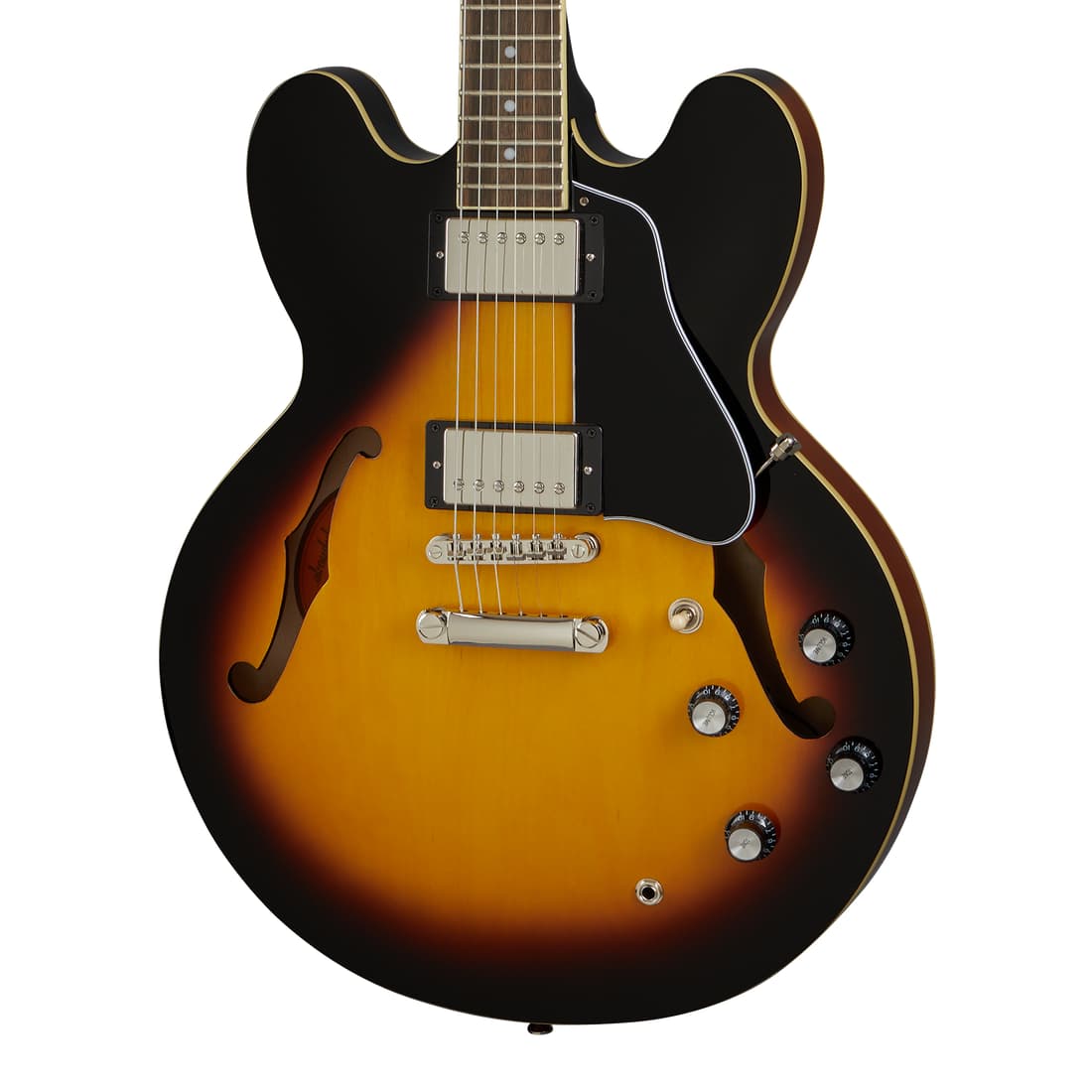
The Dot is Epiphone’s long-running affordable take on the Gibson ES-335. The name comes from its dot fingerboard inlays. More recent guitars use ES-335 branding, but there’s no single specification shared by every Dot and every Epiphone 335.
The familiar recipe is a large, thin, double-cutaway body, laminated panels around a centre block, two humbuckers, a Tune-O-Matic bridge and a stopbar tailpiece. It covers clean jazz, blues, soul, indie rhythm guitar and overdriven rock without needing special switching.
Older Dots generally have Epiphone Alnico Classic pickups. Many later ES-335s have Alnico Classic PROs. I wouldn’t budget for new pickups before hearing the guitar through my amp: pickup height, strings and amp settings can make an unremarkable first impression much better.
The older ES-335 Pro and some Traditional Pro editions add push-pull coil-splitting. A split humbucker gives you a lower-output single-coil sound, with the accompanying hum; it doesn’t turn the guitar into a Strat. A pickup with “PRO” in its name doesn’t, by itself, prove the guitar has splitting.
There are meaningful differences even among recent base models. The earlier Inspired by Gibson ES-335 lists a rounded C neck and laurel fingerboard; newer rosewood-fingerboard editions change parts of that recipe. “Current ES-335 specs” aren’t a reliable description of a used one.
Who it suits: someone buying their first semi-hollow, especially if they want to keep the controls simple. A good used Dot or ES-335 is also a sensible benchmark against which to judge more expensive models.
Dot Studio, Figured and reissue versions
- Dot Studio: a stripped-back semi with simpler decoration and typically a master volume and tone. Some editions have different body woods from the regular Dot. Buy it for the price and feel, rather than assuming it’s an identical Dot with missing binding.
- ES-335 Figured: figured outer veneers and finish choices are a major part of the appeal. Check the pickups and neck for that edition; figured wood alone doesn’t promise a better amplified sound.
- 1962 ES-335 Reissue, Inspired by Gibson Custom: a higher tier with Gibson Custombucker pickups, a long-tenon neck joint and upgraded electronics. It has a slim 1960s neck, rather than simply being the base ES-335 with block inlays.
Epiphone spells out the upgrades on its 1962 ES-335 Reissue page. It’s worth comparing a used premium Epiphone with the actual alternatives at the asking price, rather than treating every Epiphone as an entry-level guitar.
ES-339, ES-339 Pro and Ultra
The ES-339 shrinks the body, while keeping a conventional approximately 629 mm (24.75-inch) scale. It’s easier to tuck under your arm and less likely to make your picking shoulder reach around a broad lower bout.
That doesn’t shorten the fret spacing. It also doesn’t guarantee a particular weight: ask the seller to weigh the guitar if that matters.
The ES-339 Pro has coil-splitting; the standard Inspired by Gibson ES-339 has a more conventional control layout. The Ultra-339 adds a NanoMag pickup and powered electronics, with additional outputs and functions. Check every function, the battery compartment and any computer connection you intend to use. Older digital extras can be harder to repair than a passive pickup circuit.
Who it suits: someone who wants a semi-hollow but finds a 335 physically awkward. Don’t pay extra for an Ultra unless its extra sounds or connections solve a problem you actually have.
Sheraton and Riviera — read the whole name
Sheraton II and Sheraton II Pro
The Sheraton II occupies much the same musical territory as a 335, with more elaborate binding, gold hardware and block-and-triangle inlays. Many have a multi-piece maple neck, which can feel quite different from a mahogany-necked 335.
The Sheraton II Pro has a five-piece maple/walnut neck, ProBucker 2 and 3 full-sized humbuckers, and individual coil-splitting through the volume controls. Earlier Sheraton IIs generally lack that combination; check for modifications.
A well-priced II Pro is high on my used shortlist. You get extra sounds and decoration without committing to a more specialised body design. But gold plating and inlays don’t make a worn fretboard or an uncomfortable neck disappear.
Who it suits: someone who likes a 335’s flexibility but wants the ornate Epiphone look. Weigh the actual guitar; don’t assume every Sheraton is heavier than every Dot.
Sheraton with a Frequensator
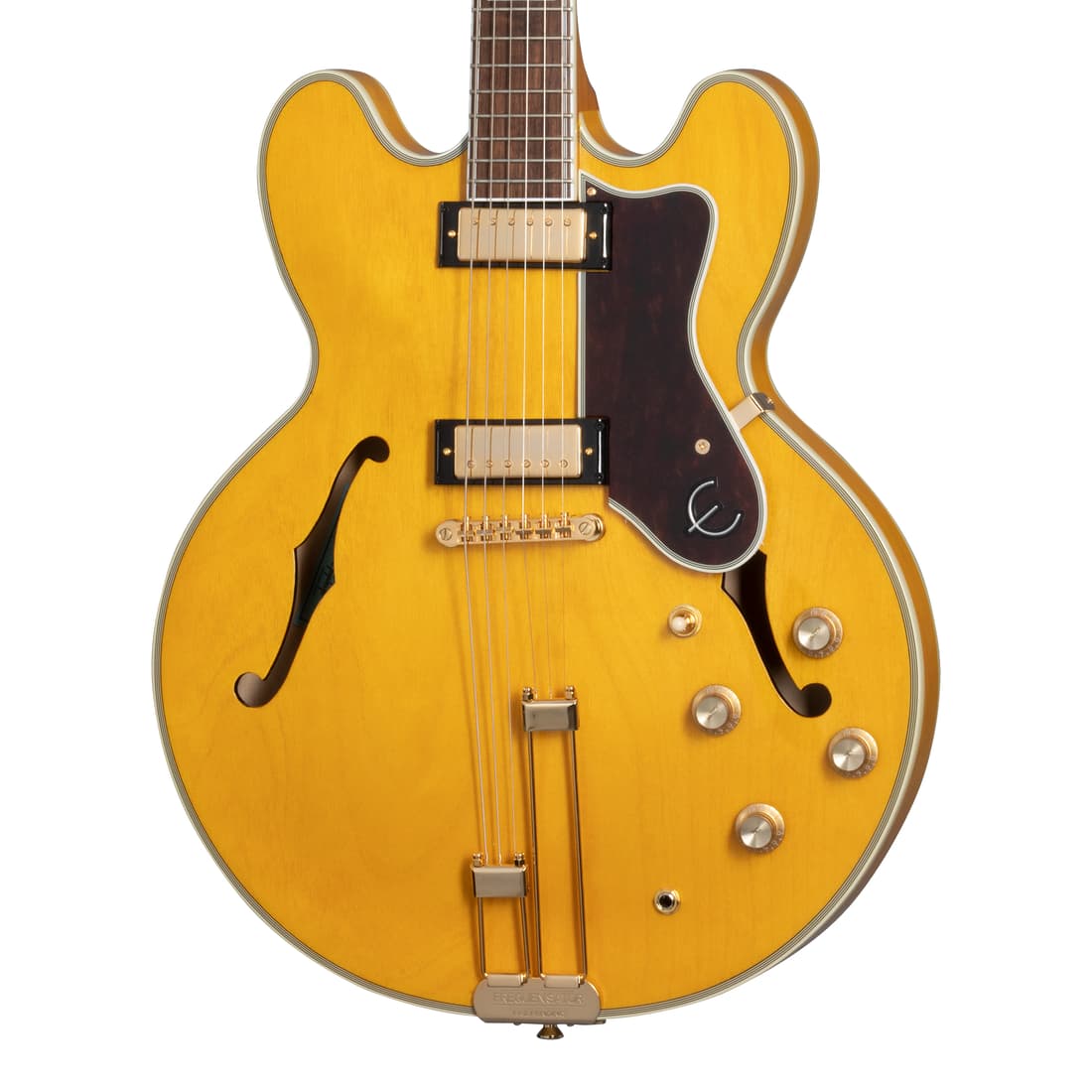
The Frequensator-equipped Sheraton is a different proposition from the II Pro. The modern example has mini-humbuckers and a mahogany neck. Its two-part tailpiece anchors the strings at different distances behind the bridge.
Mini-humbuckers generally have a tighter low end and a more focused attack than broad full-sized humbuckers. There’s still plenty of warmth available, and they cancel hum. They aren’t literally halfway between a P-90 and a full humbucker; pickup design and the surrounding circuit both affect what you hear.
The Frequensator doesn’t move like a Bigsby. You’re buying a fixed tailpiece, a different string afterlength and a very particular appearance.
There are also premium variants. The 150th Anniversary Sheraton has Gibson USA mini-humbuckers. The Masterbilt Gem Archer Sheraton has Gibson USA minis too, but uses a raised-diamond trapeze tailpiece. Neither is just a II Pro in another colour.
Who it suits: someone who wants a semi with sharper note definition, or who already has full-sized humbucker guitars and wants another voice.
Riviera
A traditional Riviera combines a 335-sized centre-block body with two mini-humbuckers and a Frequensator, with simpler decoration than a Sheraton. It’s an appealing choice for clean chord work, blues and indie rock.
The modern Royal Tan/Sparkling Burgundy version follows that recipe. But the name has also appeared on guitars with full-sized humbuckers and stopbars, particularly older editions and the Noel Gallagher and Bonehead signatures.
So if your reason for buying a Riviera is “I want mini-humbuckers,” look at the pickups. That sentence sounds ridiculous, but it saves you a surprising amount of trouble.
Riviera Custom P93
The Riviera Custom P93 takes the body in another direction: three P-90s, three volume controls, a master tone and a Bigsby. The middle pickup has its own blending control, so you have more combinations than the three-way selector initially suggests.
That’s appealing if you enjoy experimenting with pickup blends. It’s less appealing if you want to find the same rhythm sound instantly in a dark room. Test each pickup and control, and ask the seller whether anyone has altered the wiring.
The centre block helps with body feedback, but it doesn’t remove single-coil noise. And a middle pickup can get in the way of your pick, depending on how you play.
Who it suits: a player who specifically wants P-90s, blending and gentle vibrato. I’d buy it because I wanted that combination, rather than because it happened to be the cheapest Riviera.
Casino and Casino Coupe — actually hollow
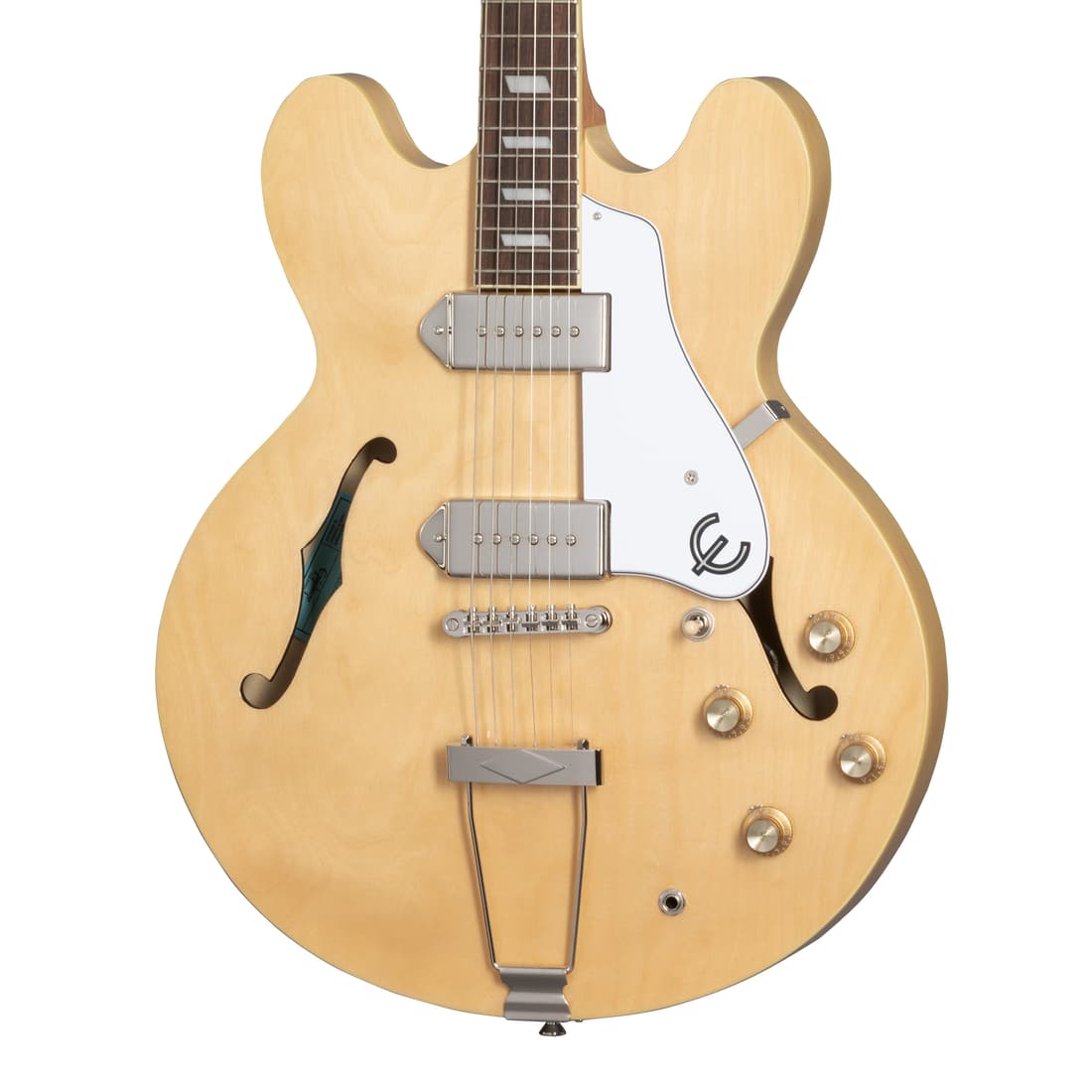
The Casino is the big fork in this shopping expedition. It looks similar to a 335, but the hollow body and P-90 pickups change the playing experience. Its connection to the Beatles helps explain why the name is so familiar.
At modest volume it can be a satisfying guitar for blues, clean rhythm parts and crunchy rock. The body’s response under your hands is part of the appeal. A thinline Casino also avoids the bulk of a deep jazz box.
I wouldn’t describe it as a replacement for an acoustic guitar. You can practise unplugged, but its acoustic volume and bass response aren’t those of a dreadnought.
The standard Casino’s neck joins the body at the 16th fret. That puts more of the upper fingerboard over the body than on a conventional 335. If you spend a lot of time high up the neck, try it before buying.
The Casino Coupe uses a smaller, ES-339-sized body and a neck joint that improves access to the high frets. It keeps the fully hollow/P-90 combination. It’s a discontinued model worth recognising when it appears used, especially if the normal Casino feels too broad.
Casinos also span several price tiers. There are ordinary import models, Inspired by John Lennon editions, Japanese Elite/Elitist examples, historical Lennon signature editions and the modern USA Casino. Those names don’t all mean the same factory, pickups or construction details. A USA Casino is a considerably different financial proposition from an ordinary used import.
Who it suits: someone who wants the hollow response and P-90 sound, particularly if their existing guitars have humbuckers. If maximum gain without squeal is the priority, I’d look elsewhere first.
The deep jazz boxes — Emperor, Broadway and ES-175
Joe Pass Emperor II and Emperor II Pro
The Joe Pass Emperor II is a traditional single-cutaway archtop, usually around 406 mm (16 inches) across the lower bout, with a spruce top, a deep hollow body, two humbuckers and a bridge on a wooden base.
That makes it an obvious candidate for chord melody and traditional jazz. You can get a rounded sound from the neck pickup without a huge effects chain. Flatwound strings are a common choice, but they’re a choice, not an admission requirement.
The older non-Pro guitar commonly has a roughly 629 mm (24.75-inch) scale and Alnico Classic humbuckers. The Emperor II Pro adds ProBuckers and coil-splitting. Both commonly have the short, roughly 629 mm (24.75-inch) scale. Some catalogue tables give conflicting figures, so check the actual guitar if scale is decisive: measure from the nut to the 12th fret and double it.
A “select spruce” top description doesn’t establish a hand-carved solid top. If a seller asks a premium for solid or carved construction, get documentation for that exact version.
Who it suits: someone who wants a dedicated jazz archtop at a used-Epiphone price. The deep body and feedback behaviour make it a less convenient first choice for loud rock.
Broadway
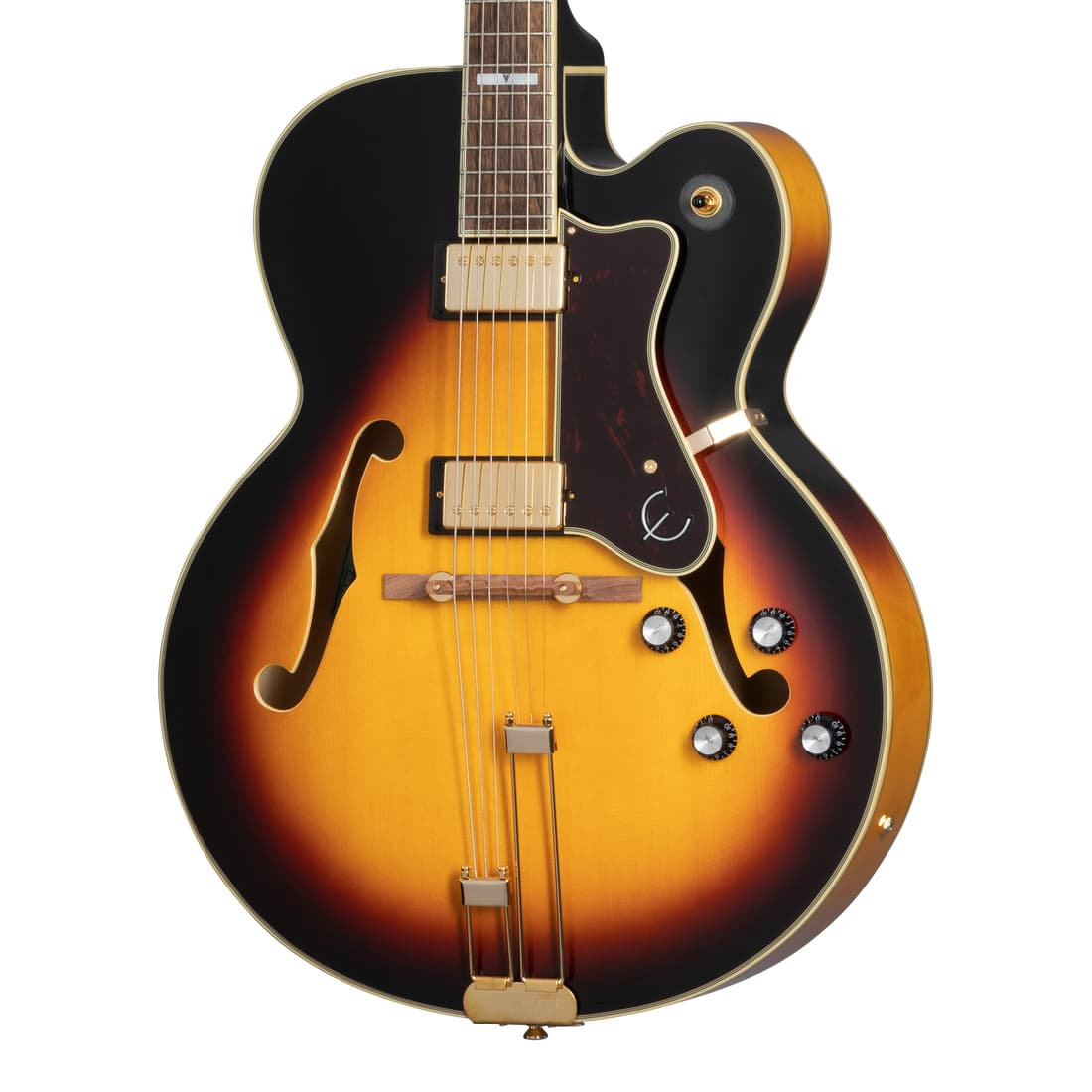
The Broadway is the bigger jazz box: typically about 432 mm (17 inches) wide, with a 648 mm (25.5-inch) scale. It combines a spruce top with two humbuckers and a Frequensator tailpiece.
Compared with a short-scale Emperor II, its longer scale means wider fret spacing and more string tension at the same gauge and tuning. Its large lower bout and deep sides also put your picking arm farther out.
Recent Broadways have Alnico Classic PRO pickups; older editions have different hardware and electronics. The body size is the first question to settle. I’d play it sitting down for a while, rather than just admire it on a stand.
Who it suits: a player who wants a large traditional archtop for jazz, swing or clean chord work and finds that body comfortable. You can play other styles on it, but you’re accepting the physical bulk and hollow-body feedback.
ES-175 Reissue and ES-175 Premium
The ES-175 is another fully hollow, roughly 406 mm (16-inch) jazz guitar, recognisable by its pointed cutaway. Its short scale and dual-humbucker layout put it near the Joe Pass in practical terms, although the body shape, top construction and neck feel differ.
The ES-175 Premium is worth distinguishing from the ordinary Reissue: Epiphone fitted Premium examples with Gibson USA ’57 Classic pickups. Don’t assume every used Epiphone ES-175 has those pickups, and check that a purported Premium still has its original pair.
Who it suits: someone who wants the Gibson-style jazz-box shape, or who finds a good Premium at a price that makes sense alongside a Joe Pass.
Emperor Swingster
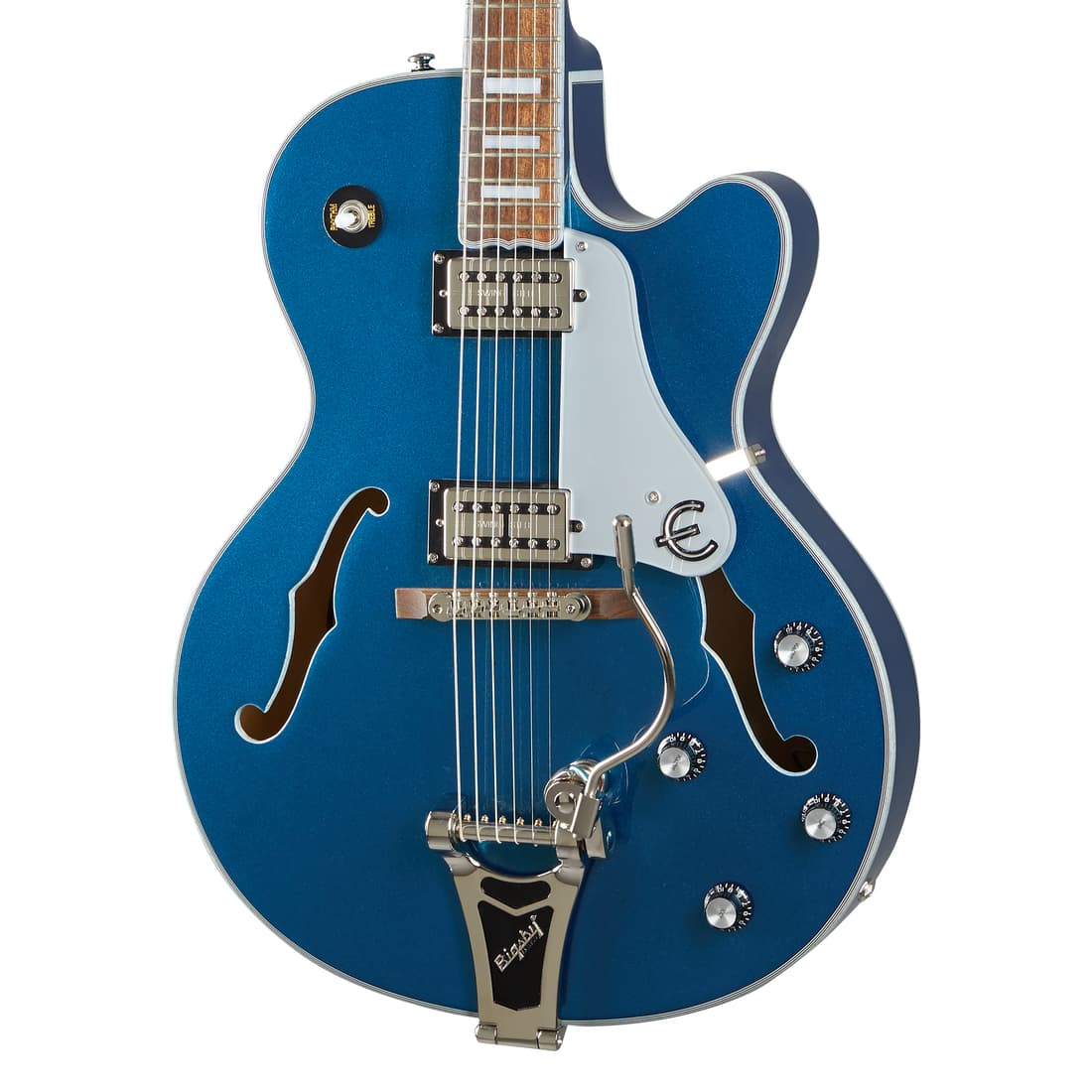
The Swingster adapts the deep archtop idea for rockabilly, swing, country and vintage rock. Two SwingBucker pickups and a Bigsby give it a very different remit from a plain jazz box.
Its push-pull controls switch the coils within each humbucker between series and parallel. Parallel wiring generally reduces output and gives a clearer sound while keeping hum cancellation. That’s different from the coil-splitting on a Sheraton II Pro.
The later maple-bodied Swingster has a pinned wooden bridge base. Older versions used a different top/neck recipe and bridge arrangement, so check the year before following setup advice.
Who it suits: someone who wants a deep hollow guitar for twang and gentle vibrato, with more pickup flexibility than a conventional jazz box. It’s still fully hollow; the Bigsby hasn’t installed a centre block.
Wildkat, Alleykat, Flamekat and Uptown Kat
These are smaller, single-cutaway guitars. The older Kats use chambered bodies, so they’re a separate branch from both the laminated 335 family and the fully hollow Casino.
| Model | Typical specification | The reason to look at it |
|---|---|---|
| Wildkat | Two dogear P-90s, usually a Bigsby, separate pickup volumes plus master volume and tone | A compact P-90 guitar with vibrato. Check its weight and tuning behaviour. |
| Alleykat | Full-sized bridge humbucker, neck mini-humbucker, stopbar | An unusual pickup pairing with simple fixed hardware. |
| Flamekat | Two mini-humbuckers, Bigsby, flames and dice decoration | The retro styling is a large part of the point. |
| Uptown Kat ES | ES-style semi-hollow construction, two FB720 mini-humbuckers, stopbar | A later Kat design with its own pickup and construction recipe. |
Epiphone’s Wildkat specification lists a mahogany body and maple top. “Small” and “hollow” don’t automatically mean light when there’s substantial wood and a Bigsby involved.
The Uptown Kat ES changes the construction and uses FB720 pickups. Don’t treat its mini-humbuckers as an identical set to those in a Riviera or vintage-style Sheraton.
I’d look at an Alleykat if I wanted a neck mini-humbucker without a Frequensator, and a Wildkat if I wanted a small P-90/Bigsby guitar. I’d check the body balance and control layout before getting too attached to the name.
ES-345, ES-355, Lucille and the modern Futura
The 345 and 355 keep the broad centre-block ES concept but add trim and, on some versions, different switching or vibrato hardware. The number on the headstock doesn’t establish a universal set of electronics.
| Version | What changes | What to check |
|---|---|---|
| ES-345 | Split-parallelogram inlays and upgraded trim; Varitone and Bigsby on certain editions | Does this exact guitar have Varitone, vibrato or unusual output wiring? |
| ES-355 / 1959 ES-355 | More elaborate binding and block inlays; higher-tier versions can have Gibson Custombuckers | Don’t assume every 355 has stereo, Varitone or a vibrato. The 1959 Inspired by Gibson Custom version uses a stopbar. |
| B.B. King Lucille | No f-holes, humbuckers, Varitone; many versions have stereo/mono jacks and a TP-6 fine-tuning tailpiece | Test all Varitone positions and both outputs. It’s still a centre-block semi. |
| Futura ES-355 | Modern neck, stainless steel frets, compound radius, locking tuners and extra pickup switching | A different playing specification from a vintage-style 355. |
A Varitone switches among filtered sounds, including a bypass position. It isn’t a six-way pickup selector and it doesn’t split the humbuckers. On Lucille, the extra controls are part of the appeal if you like those sounds, and extra things to test if you don’t.
The Futura ES-355 deserves its own mention. It has 22 stainless steel frets, a compound fingerboard radius of approximately 254–356 mm (10–14 inches), locking Grover tuners, and ProBucker Ignite humbuckers with coil-splitting and phase options. Its centre block also has a weight-relief window.
That flatter upper fingerboard and the modern neck may interest you if you like broad bends and less vintage neck shapes. Buy it for those differences; a colour-shifting finish alone won’t make it more comfortable.
The signatures and discontinued names you’ll see in listings
Artist names can mean a different pickup configuration, neck or circuit. They can also mean you’re paying for an association. Here are the ones I’d pause to identify.
| Model or edition | What makes it different |
|---|---|
| Noel Gallagher Riviera / Bonehead Riviera | Full-sized Alnico Classic PRO humbuckers and stopbar tailpieces on the modern signatures. They follow the older humbucker Riviera branch. |
| Noel Gallagher Supernova | A discontinued 335-style semi with full-sized humbuckers. Don’t confuse a Union Jack Supernova with every Union Jack Sheraton. |
| Nick Valensi Riviera P94 | Humbucker-sized P-94 single-coils. The large covers don’t make them humbuckers. |
| Tom DeLonge ES-333 | A centre-block semi with one high-output bridge humbucker and a volume control. An intentionally narrow control set. |
| Dave Grohl DG-335 | 335-style semi with diamond soundholes, a six-in-line headstock and Gibson USA Burstbucker 2/3 pickups. |
| Emily Wolfe Sheraton Stealth | A full-humbucker Sheraton variation with diamond soundholes and a simplified control arrangement. |
| John Lee Hooker / 1962 / 150th Anniversary Sheratons | Vintage-style Sheraton branches with mini-humbuckers; tailpieces and production arrangements differ. Identify the exact edition. |
| Masterbilt Gem Archer Sheraton | Premium semi with Gibson USA mini-humbuckers and a raised-diamond trapeze. “Masterbilt” here doesn’t mean an acoustic guitar. |
| Alex Lifeson 1976 ES-355 Reissue | Gibson T-Type humbuckers, Maestro Vibrola and a mono Varitone with a bypass switch. |
The manufacturer pages for the Noel Gallagher Riviera, Bonehead Riviera, DG-335 and Lifeson ES-355 show why “signature Epiphone semi” isn’t a single specification.
More hollow and semi-hollow families
| Name | What you’re looking at |
|---|---|
| Sorrento | A thin, fully hollow single-cutaway family. Vintage models used mini-humbuckers; some later reissues have P-90s, and the 50th Anniversary 1962 version has Gibson USA minis. |
| Inspired by 1966 Century | A thin fully hollow guitar with a single P-90 and no cutaway. Different from the Masterbilt Century acoustic range. |
| Emperor Regent | A large hollow jazz archtop, commonly with a floating neck mini-humbucker and a longer scale. The floating pickup leaves more of the top untouched. |
| Zephyr Regent | A deep hollow single-pickup jazz guitar. Don’t conflate it with every Zephyr-branded instrument. |
| Zephyr Blues Deluxe | A large hollow guitar with three P-90s and individual pickup volumes. |
| 150th Anniversary Zephyr DeLuxe Regent | A fully hollow guitar with two NY mini-humbuckers and a 648 mm (25.5-inch) scale. |
| ES-295 / ES-295 Premium / Scotty Moore editions | Deep hollow rockabilly-style guitars, commonly with two P-90s and vibrato hardware. Pickups and bridges vary by edition. |
| Les Paul ES Pro | A laminated, ES-style semi in a Les Paul outline, with ProBuckers and coil-splitting. |
| Les Paul Standard Florentine Pro | A chambered/semi-hollow Les Paul variation. Identify it separately from the Les Paul ES Pro and from ordinary weight-relieved Les Pauls. |
| Elite / Elitist Byrdland and Country Deluxe | Higher-priced Japanese-made Gibson-derived archtops. The Byrdland’s unusually short scale and the Country Deluxe’s large thin body put them outside the normal Dot/Casino comparison. |
The 150th Anniversary Zephyr DeLuxe Regent is a good example of why the suffix matters. It has two mounted pickups, unlike the single-pickup Zephyr Regent in older catalogues.
Epiphone’s 2003 catalogue documents the older Kat and Zephyr combinations, and its 2018 catalogue documents several later discontinued editions. At the historical end, names such as De Luxe, Triumph, Broadway, Emperor, Spartan, Devon, Blackstone and Granada also appear on vintage Epiphones. Some started as acoustic archtops; some have electric relatives. Once you’re shopping those, originality, structural condition and the exact period matter far more than this modern used-buying shortlist.
And the Masterbilt Century acoustic archtops?
The Olympic, Zenith, Zenith Classic, De Luxe and De Luxe Classic in the Masterbilt Century range are acoustic archtops with an acoustic-style pickup system. Their f-holes and arched tops can put them in the same search results, but they’re a different buying decision from a Casino or Sheraton.
They make more sense if you want an acoustic archtop sound and feel for rhythm playing or songwriting. “Classic” in this range identifies the f-hole versions of the Zenith and De Luxe, rather than a better grade of electric humbucker guitar.
Which Epiphone suits which music?
These are starting points, not rules. Strings, pickup height, your amp and how you play can move a guitar a long way from the stereotype.
| Your priority | Where I’d start | Why |
|---|---|---|
| One guitar for clean and driven sounds | Dot / ES-335, ES-339, Sheraton II Pro | Two humbuckers and a centre block cover a broad set of jobs. |
| Blues, soul and indie with more focused attack | Mini-humbucker Riviera or Sheraton | Hum cancellation, centre-block feedback resistance and relatively clear pickup response. |
| Beatles-style textures and gritty blues | Casino / Casino Coupe | P-90 attack and fully hollow response, provided you can manage the volume. |
| Traditional jazz and chord melody | Joe Pass Emperor II, ES-175, Broadway | Deep archtop bodies and neck humbuckers suit rounded clean sounds. Choose the size you can live with. |
| Rockabilly and gentle vibrato | Swingster, Wildkat, ES-295 | Vibrato hardware and pickup combinations suited to that vocabulary. |
| Loud rock with substantial gain | Humbucker-equipped centre-block models; DG-335 or ES-333 if their specs appeal | Better control of body feedback than the fully hollow family. |
| Compact body | ES-339 for humbuckers; Casino Coupe for hollow/P-90s; Kat models for their specific combinations | Body comfort without assuming every small guitar behaves the same way. |
For maximum versatility, I’d start with two humbuckers and a centre block. Coil-splitting or series/parallel switching broadens the menu, but I’d still put the neck and the main pickup sounds first.
If you want a P-90 voice without committing to a hollow body, my Yamaha Pacifica 311H is another combination worth knowing about: a neck P-90-style pickup and bridge humbucker on a solid body. The hollow construction is a separate choice.
Pickups, tailpieces and necks — what actually matters
A full-sized humbucker often gives you a broader, thicker sound; a mini-humbucker often tightens the bass and concentrates the attack; a P-90 usually has a pronounced single-coil edge. Those are tendencies. A dark circuit or high-output pickup can overwhelm the stereotype.
And a gold cover tells you almost nothing. Gibson USA pickups, Epiphone ProBuckers, older Alnico Classics and a previous owner’s replacement pickups can all sit under similar-looking covers.
| Hardware | Practical consequence |
|---|---|
| Stopbar + Tune-O-Matic | Straightforward string changes and individually adjustable saddles. Usually the simplest first purchase. |
| Trapeze / Frequensator | Fixed string anchor at the end of the body. String afterlength changes, but there’s no vibrato arm. Make sure your strings reach the tuners. |
| Bigsby | Gentle pitch movement, extra weight and a more involved restring. Nut slots, string winding and bridge friction affect tuning return. |
| Floating bridge on a wooden base | String pressure holds an unpinned base in position. Moving it changes intonation, so preserve its position during restringing. |
| Pinned bridge base | Pins locate the base. Check the saddles and setup too; pins don’t establish correct intonation by themselves. |
A trapeze tailpiece doesn’t prove a guitar is fully hollow: Rivieras and Frequensator Sheratons have centre blocks. A Bigsby doesn’t prove it either.
The neck is where I’d be especially fussy. A five-piece Sheraton II neck, a rounded-C 335 and a slim vintage-style neck may all fit under “comfortable” in a listing. Your hand gets the deciding vote.
Try bends at the high frets, chords near the nut and the playing position you normally use. Check the nut width and shoulder shape, not just the words “SlimTaper.” Fretboard wood is farther down my list than fret condition and whether I enjoy holding the guitar.
Buying used without buying a repair project
- Identify the version. Get clear pictures of the whole guitar, headstock front and back, internal label, pickups, bridge and controls. Match the serial and model to documents; serial-number decoding alone doesn’t establish the exact specification or authenticity.
- Inspect the neck and headstock. Look for repaired breaks, cracks around the joint, finish changes and a twisted neck. Play every fret. Deep wear or high frets can erase a cheap asking price.
- Check the top and bridge support. Look for abnormal sinking or bulging, lifted bridge posts and separation at seams. A normal arched top isn’t damage; a distorted top or poor neck angle can be expensive damage.
- Look at the remaining adjustment. If the bridge is already bottomed out and the action is still high, don’t accept “just needs a setup” without a competent assessment.
- Plug it in. Test each pickup, every knob, the selector and any push-pull switches. On Lucille or Ultra models, test the extra outputs and modes too. Listen for intermittent connections, not just crackle from a dusty pot.
- Test at realistic volume. A clean bedroom audition won’t tell you whether a hollow guitar behaves at rehearsal gain. Uncontrolled squeal can come from the body or a microphonic pickup; repairs differ.
- Check bridge placement and tuning. Compare open notes and 12th-fret notes with a tuner. On a floating bridge, check that the base fits the top; on a Bigsby guitar, use the arm and see whether the pitch returns.
- Ask about modifications. Request original parts and evidence of pickup changes. Many semis lack a rear electronics hatch, so replacing the wiring through an f-hole or pickup opening takes extra labour.
- Include the case and setup in the price. Make sure the case supports the neck and fits the actual model. A 339 isn’t the same fit as a 335, and a deep Broadway needs a different case.
I wouldn’t automatically pay a large premium for “Made in Korea.” Good Korean guitars exist, and so do good Chinese guitars. Country of manufacture doesn’t tell me whether this guitar has worn frets, a bad nut or a neck I dislike.
I’d also distinguish a label saying Epiphone Limited Edition Custom Shop from Inspired by Gibson Custom and from a guitar built by Gibson Custom in the USA. Those labels describe different things. A stamp alone doesn’t establish the expensive one.
Value and resale — what I’d actually search for
If I’m buying a guitar to enjoy and perhaps move on later, the purchase price matters as much as the model. A recognisable guitar bought too dearly still loses money.
I’d compare completed local sales for the exact version, then subtract likely setup work and selling costs. Active asking prices tell me what sellers hope for. They don’t establish what buyers paid.
| Priority | My shortlist | The condition attached |
|---|---|---|
| Lowest-cost all-round entry | Dot, standard ES-335, ES-335 Pro | Buy a clean example at a price supported by comparable sales. A Pro is attractive if its premium is modest. |
| More ornate all-rounder | Sheraton II Pro | Worth paying somewhat more if you like the neck, ProBuckers and splitting. Don’t pay primarily for worn gold plating. |
| Semi-hollow with a different pickup voice | Mini-humbucker Riviera or Frequensator Sheraton | Identify the correct version. The right buyer may take longer to find than for a basic 335. |
| A substantially different addition to humbucker guitars | Casino / Casino Coupe | Choose it because you want the P-90/hollow combination, and can use it at your intended volume. |
| Dedicated traditional jazz guitar | Joe Pass Emperor II / ES-175 | Can be appealing used, but a more specialised audience can mean slower resale. |
My first search would be a good Dot or ES-335, followed by a Sheraton II Pro if the asking price were close. Those are easy to explain in a future listing and don’t require a buyer to want a rare artist edition or specialised circuit.
I’d keep original parts if I modified anything. Expensive pickup and wiring upgrades rarely come back dollar-for-dollar at resale. I’d be especially cautious about drilling for a Bigsby on a guitar I already expected to sell.
Rarity can attract a collector, but it can also mean hardly anyone is looking. A signature premium, discontinued colour or “vintage Korean” claim needs evidence from actual sales.
So, which would I buy?
If I wanted my first affordable semi-hollow, I’d buy the best-playing, sensibly priced Dot, ES-335 or ES-339 I could find. I’d choose the 339 if the larger body annoyed me. I’d take a Sheraton II Pro over a similarly priced plain 335 if I preferred its neck and appearance.
If I already had several dual-humbucker guitars, I’d be more interested in a Casino, or a mini-humbucker Riviera if I needed to play louder. They give me a stronger reason to pick up a different guitar.
And if the whole point were to sit down and play jazz on a deep archtop, I’d look hard at a used Joe Pass Emperor II or ES-175. The deep body and floating bridge are part of the appeal, provided they fit the way you play. Fortunately, by that stage, you can stop looking at twenty Sheratons.