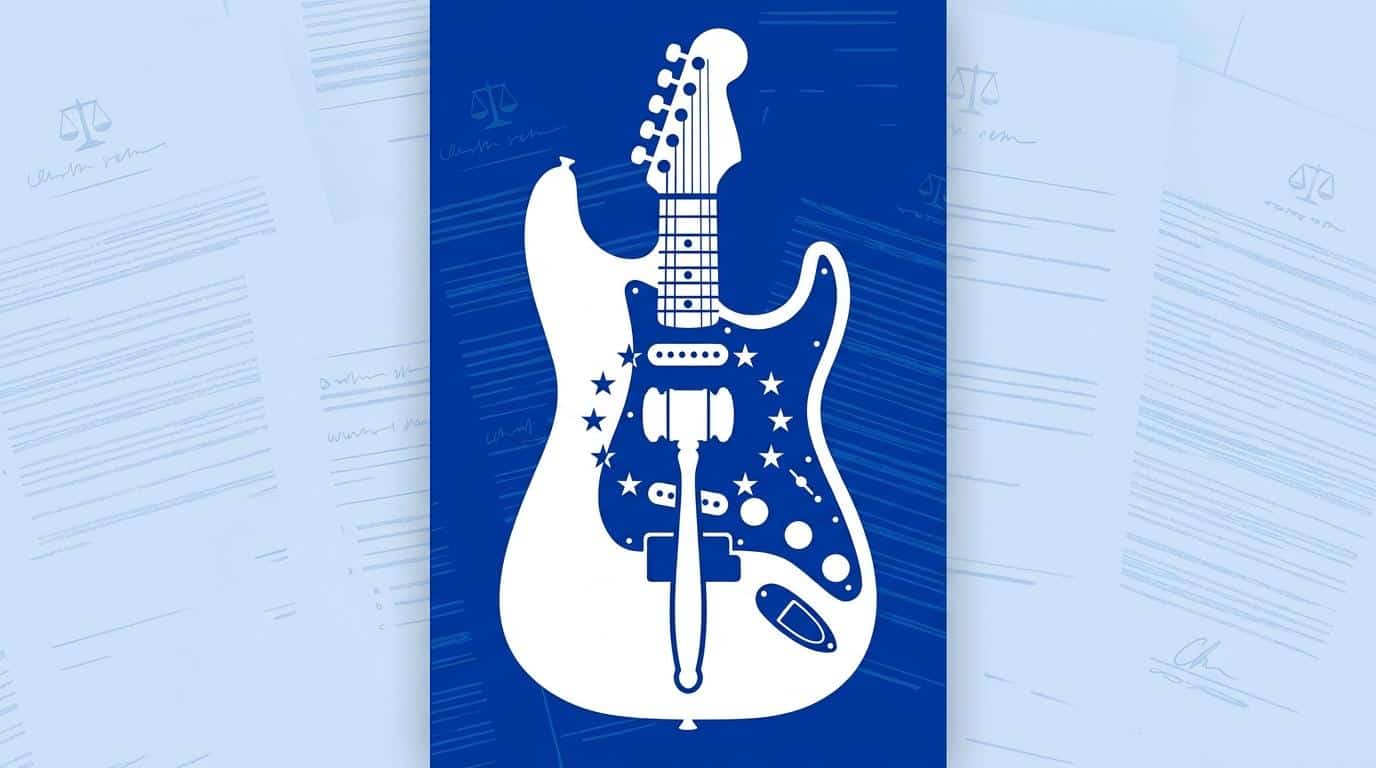
Fender’s Copyright Win in Europe: Facts vs Fiction
Fender’s German court win is real. The internet’s reaction, as usual, is over-the-top, and riddled with mistakes.
Headlines are sloppy, and bloggers’ and YouTubers’ interpretations of it are loosey-goosey, getting. Designs like the Strat or Tele traditionally have been trademark (or trade dress), but this was a copyright win in Germany over the Stratocaster body shape as a work of applied art (rws-verlag.de).
I watched some YouTube analysis on this that was totally off the mark, with conclusions drawn like.
- “This is disastrous for Fender’s branding.” It’s not. A company has to defend its IP, or evidence of not doing so can be used against it.
- “Charvel, owned by Fender, can now no longer make Stratocaster-shaped guitars.” Did they forget that you can license a copyright?
- “I’m never buying a Fender again!” They won’t notice, and you probably already weren’t going to.
I’ll explain what happened below, and discuss realistic implications.
What the court actually did
Some background first. The case was brought against Yiwu Philharmonic Musical Instruments Co., a China-based seller offering Strat-style guitars through AliExpress.
AliExpress (and Temu, Shein, etc.)-based vendors sell near-exact copies visually. They’re never great guitars without a lot of work, but they bear the shape and the logo.
The Regional Court of Düsseldorf found that the Stratocaster body design qualifies for copyright protection under German and EU law, and that Fender can enforce that right against guitars manufactured, sold, or distributed into Germany or the EU, even if they are made elsewhere.
The annoying little wrinkle: this appears to have been a default judgment. German commentary says Yiwu didn’t show up or defend the case, so the court issued a Versäumnisurteil. Translation: Fender won, but nobody serious got to cross-examine the theory and kick the tires. (bardehle.com)
What Fender actually gained
Fender did not magically gain the right to ban all S-style guitars in Europe. What it got is much more practical and much less cinematic: a German judgment it can wave around when a manufacturer, importer, distributor, or retailer is selling near-identical Strat copies into the EU. That is useful leverage, especially against cheap catalogue guitars that go for the full Strat silhouette buffet. (conventuslaw.com)
If you want the practical version of this entire argument, my Yamaha Pacifica piece is a useful companion read. Ebullient Praise for the Yamaha Pacifica Standard Plus (PACS+12)
This lets Fender pressure copycat manufacturers without needing to sue everyone, letting Fender see who folds, and who fights.
But it doesn’t mean Fender has some kind of enforceable legal superiority over everyone who makes S-type guitars.
This is why it’s important to note that it’s a cease-and-desist. A letter is not a suit, nor a judgement, nor is it “served” to people. It is the opening move, and sometimes the only move. A cease-and-desist letter basically says “Hey, don’t do that!” and may not ever be able to be followed by anything else.
Smaller builders and resellers may capitulate (or at least modify the way they do things slightly) because the cost of fighting a German/EU copyright case is nonsense-tier high compared with just changing a body outline and moving on with their lives. That is the real power here. (conventuslaw.com)
In the U.S., Fender previously lost trademark protection battles over the Stratocaster, Telecaster, and Precision Bass body shapes because the designs had become too common to function as source identifiers.
In Germany, Fender side-stepped that fight by using copyright, not trademark. The argument is not “this body shape means Fender.” The argument is “this is original creative expression, and this guitar copied it.” If a court accepts that, it is a much stronger weapon. It is also much more annoying for everyone else who has spent 70 years treating the Strat outline like common guitar folklore. (bardehle.com)
The obvious pressure point is budget S-style imports. Brands like Jet, especially where their models are sold through EU retailers and presented as Strat-ish or Tele-ish shapes, are the kind of thing Fender can lean on first. Not because they are unique villains. Because they are easy targets: close copies, low margin, and not worth a legal cage match for most sellers. (guitar.com)
If you want to see how far a good non-Fender S-type can go, I’ve written about the Yamaha Pacifica 311H before, and that post still feels relevant here.
The likely outcome, not the fantasy outcome

- Cheap near-copies become riskier in Europe.
- Some retailers quietly delist or relabel products.
- Some builders tweak contours, pickguards, and jack placement.
- A serious defendant eventually challenges the scope of the ruling.
So no, I do not think this means “all Strat-style guitars disappear.” That is media-catnip, not a realistic market outcome. More likely, Fender has just made the cheapest, closest copies more uncomfortable to sell in Europe. Which, to be fair, is exactly the kind of move a company makes when it is tired of watching the same silhouette get photocopied for decades. (conventuslaw.com)
This is a meaningful enforcement tool, not a civilization-ending ban on every guitar with a similar vibe. Big difference. Tiny detail. Everybody online ignored it, obviously.
My read is simple: legally important, commercially real, culturally overhyped. Fender got a useful European cudgel. It did not get the final word on S-style guitars. And unless a serious defendant fights this in earnest, the internet will keep pretending a default judgment against one Chinese seller is the same thing as the end of guitar design. It is not. It is just the opening scene.