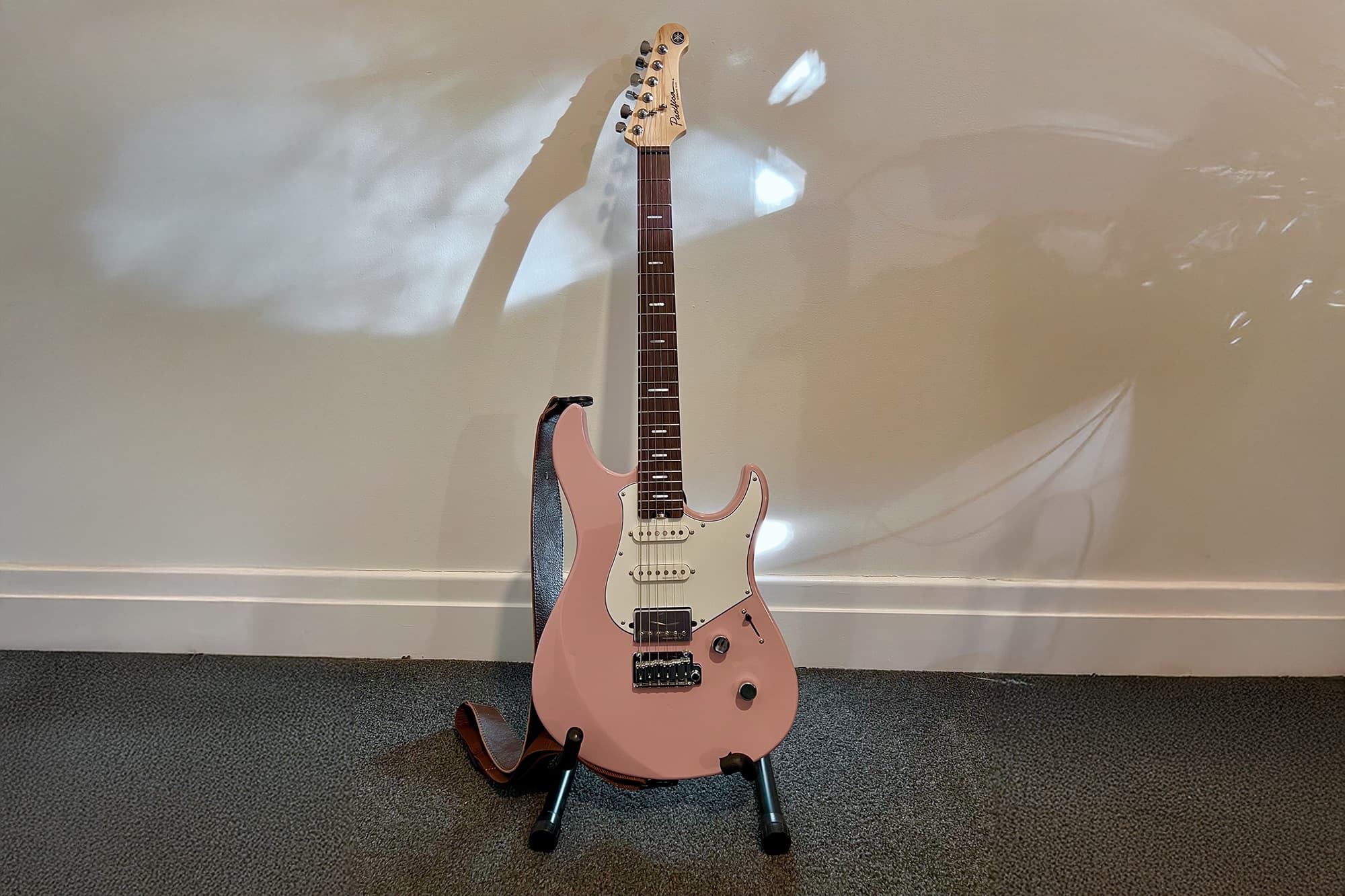
Ebullient Praise for the Yamaha Pacifica Standard Plus (PACS+12)
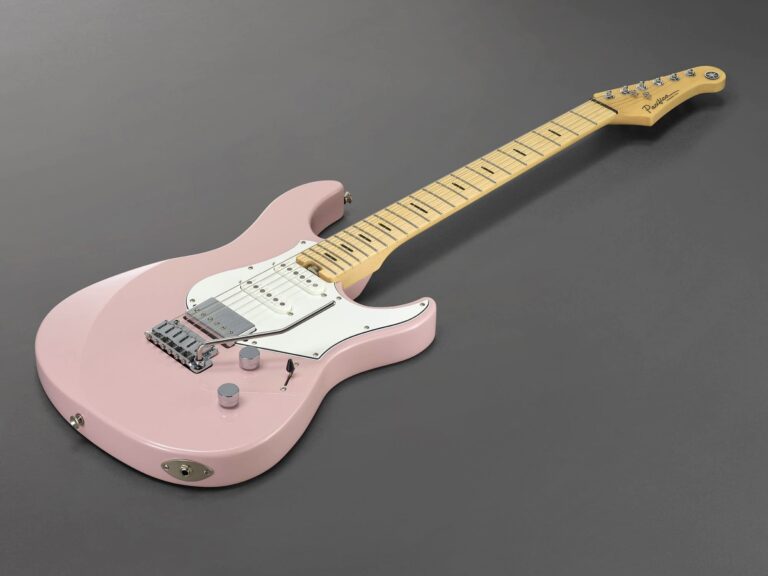
I’ve played the guitar on and off for around 25 years. Mostly off. Recently, as I got back into it with a larger budget, I have gone through a few variations on the “Stratocaster” type guitar before landing on what I think is the best one for me, and maybe for you: the Yamaha Pacifica Standard Plus, also less sexily known as the PACS+12.
I’m writing this review of the Pacifica Standard Plus because too few people have written about it. It’s easy, as a guitarist anywhere up to the “I’m pretty good, I guess” level, to walk into a guitar store and be bedazzled by colours and shapes. It’s hard to pick, so you go with whatever they tell you and whatever feels good in your hand. Actually, the whole process reminds me a lot of how hard it is to buy one’s first motorcycle.
So I’m doing something similar and writing down what might be useful for relatively beginner guitar buyers, looking for a great machine on which to hone their craft.
The Yamaha Pacifica Standard Plus — In a Nutshell

In a nutshell, the Yamaha Pacifica Standard Plus is a high-quality guitar, made by a renowned manufacturer, with awesome features, crystal clear sound, and excellent quality control, that you can get at a bargain price (as low as $1200 in Australia, or $800 equivalent, if you wait around for discounts… a few times a year).
Guitars tend to get more expensive for one of three reasons:
- Brand. Fender and Gibson guitars cost more, even if they’re the same, or even worse than the competition. Even if they don’t look as good.
- Features. Bits that make guitars more reliable or better sounding make guitars more expensive.
- Quality control. There are cheap guitars (even from great brands) that come with the kitchen sink of features. But randomly, they might be duds, and you have to return them. Beginners may not know this.
What you get with Yamaha guitars is instruments with loads of features, from a great brand that just doesn’t have a lot of marketing spend behind it — but ask any seasoned musician if Yamaha stuff is good quality and they’ll say “yes”. They might mention it’s not as cool, or authentic, but whatever. It’s good quality. The parts are good, and the QC is good.
And as you go up the models of Yamaha guitars, you start to get features only available on name-brand guitars that are 2-3 times the price.
The Yamaha Pacifica line starts out at the Pacifica 012, which is a basic, bare-bones guitar that many think of as a “beginner” guitar. And it ends at the Yamaha Pacifica Professional, which has some amazing features that you only get on super high-end devices, and which is made in Japan.
The Pacifica Standard Plus is “one below” the Professional. The major differences are that it doesn’t have a) a “compound radius” fretboard (that changes radius from the neck to heel), b) some resonant features in the body, and c) a “made in Japan” sticker (it’s made in Indonesia).
But in terms of everything that counts for 99.99% of players — quality, feel, sound — the Pacifica Standard Plus has everything you need. Oh, and it comes in pink — the Professional does not.
It’s worth noting that so many aspects of the Pacifica Standard Plus are high quality. The knobs, the tuners, the frets… Yamaha stuff exudes craftsmanship. I’d say the same about my Revstar (which is slightly cheaper, but still a Yamaha). It’s not until you hold one in your hands that you really get this.
In Search of a (Good) Pink Guitar
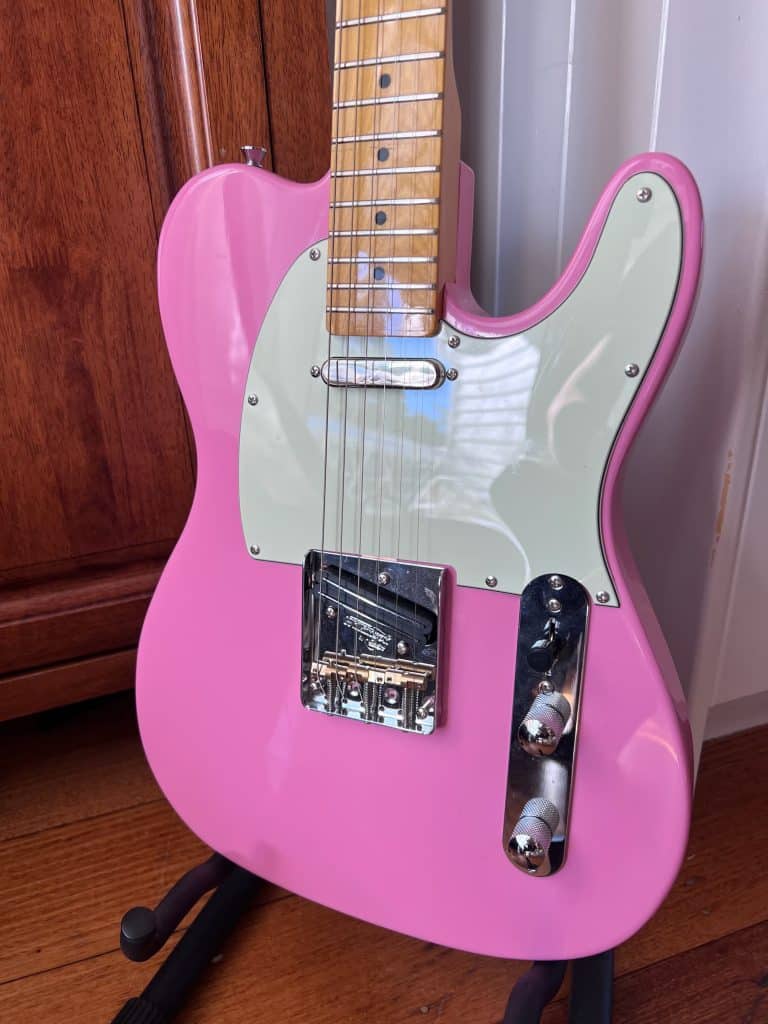
I came across this guitar because I was looking for a pink guitar. I had seen a Fender American Player II Stratocaster on Marketplace with an all-rosewood neck and a body in glorious shell pink. The seller was asking $2,400, which seemed like a lot (I’d be afraid to touch it!), so instead, I settled on a pretty gorgeous Fender Player Stratocaster — a Made-In-Mexico 70th anniversary model, also in shell pink, but with a roasted maple neck.
The shell pink Player Strat was definitely a nice guitar. Beautiful tone, lovely colour, excellent construction. It was also half the price at $1200 (second hand). I heard the first-gen Player Strats had various problems like rough fretboard edges and so on, but I found no issue with it.
My only qualms with the Player Strat was that as much as I like the look of the roasted maple neck, I didn’t like the feel of it. My hands cramped on it. It was some combination of the radius, the wood, and me being a wuss.
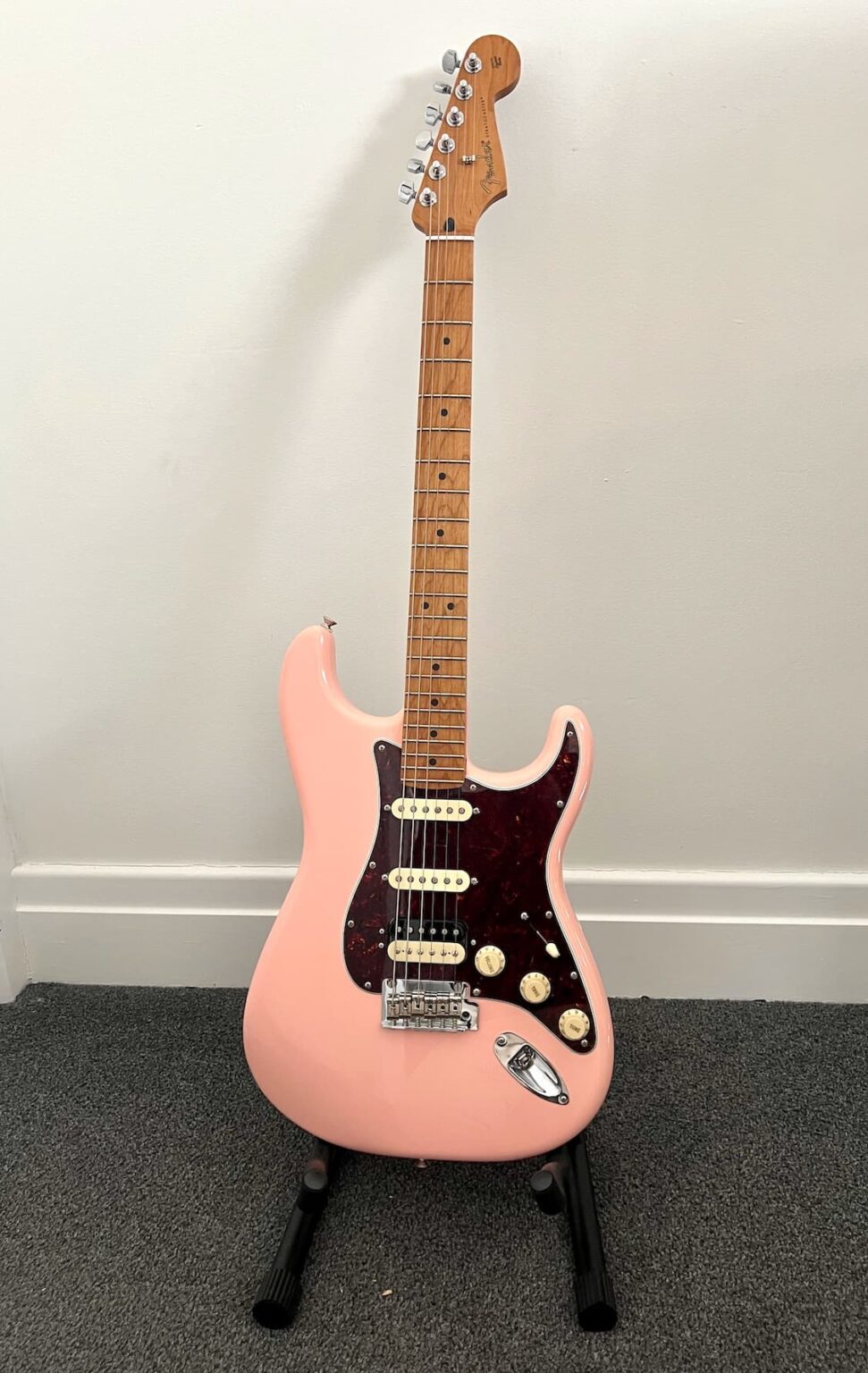
Even looking at that guitar now, I kind of regret selling it. Should I have put a mint pickguard on it?
No, the reality is, it just didn’t gel with me. One reason was the heel of the neck — I just have trouble with the old-school blocky heel of Fender Strats. They’re square. Even cheap Ibanez guitars have a round contoured heel that’s so much more comfortable. Fender gatekeeps this “feature” and only has it on guitars starting with the American Professional II.
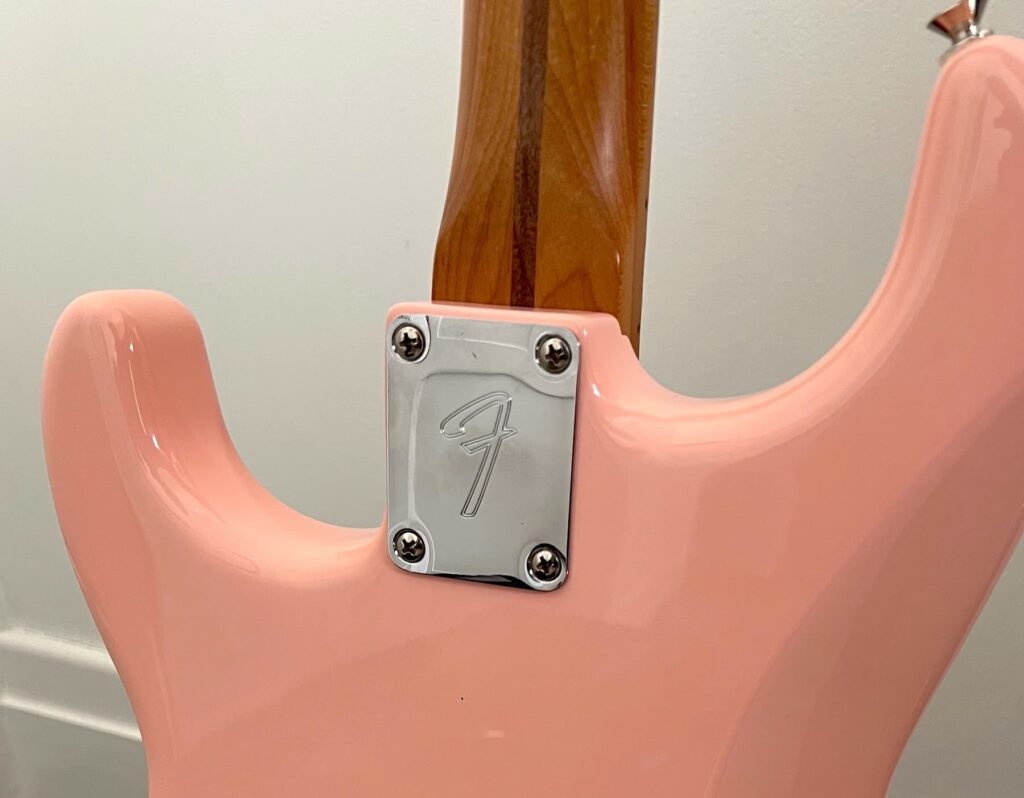
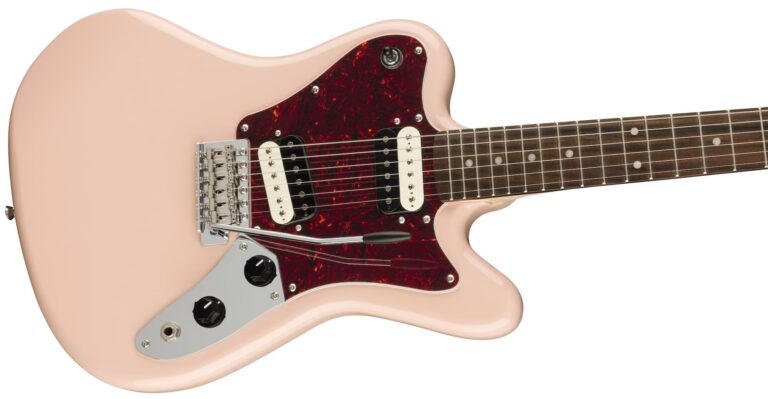
And maybe the elephant in the room about this “shell pink” Stratocaster was that the pink was off — it looks like “peach”, as my niece bluntly put it. Peach is nice, but it isn’t pink.
So I sold it. And began a hunt for another pink guitar.
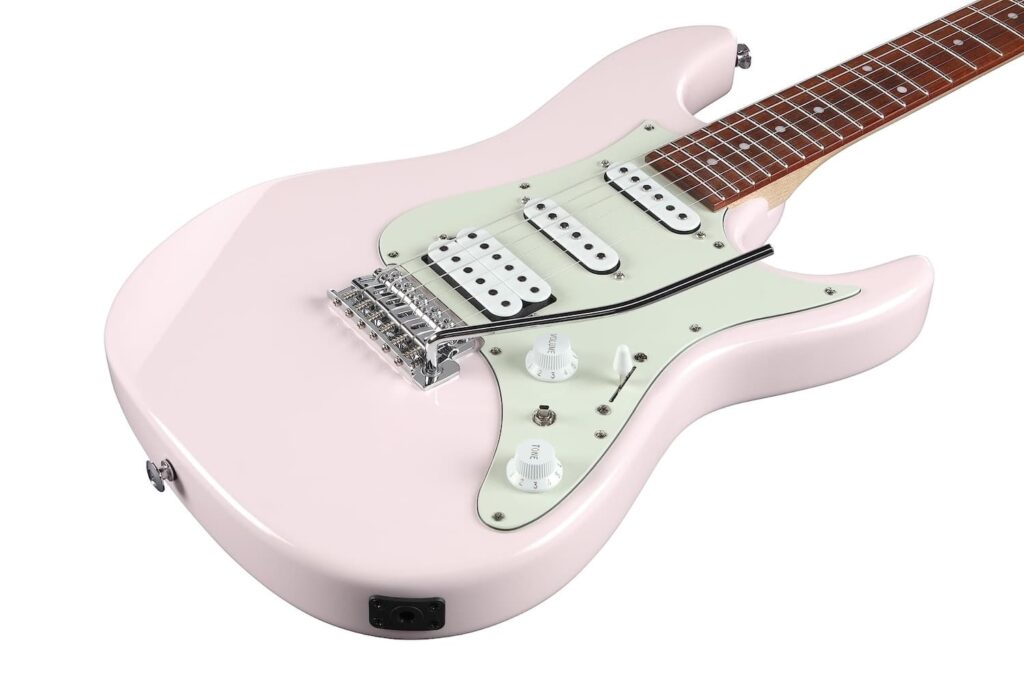
One contender was a cheap one — an Ibanez AZ Essentials. These have an HSS setup, a contoured heel, and sound decent. Not amazing. They do feel a little “light”, but so what? I very nearly bought one recently at a garage sale for a few hundred (A$370, I think) and I regret not doing so…
Then, of course, there are the other cheap guitars made by lesser-known but sometimes quality brands, like Harley Benton. They make a bunch of well-made guitars and I considered getting Thomann to ship me one all the way to Oz.
But I just didn’t feel any affinity for that brand. Not sure why. Maybe if I were in Europe and had seen them around more.
Yamaha has always called to me. They have this reputation for unimpeachable quality and even good set-up and playability out of the box, even on cheaper guitars. The 612 series is a high-spec and affordable guitar whose playability is through the roof. But there isn’t one in pink. So I looked to the next level up – the Standard Plus, or PACS+12.
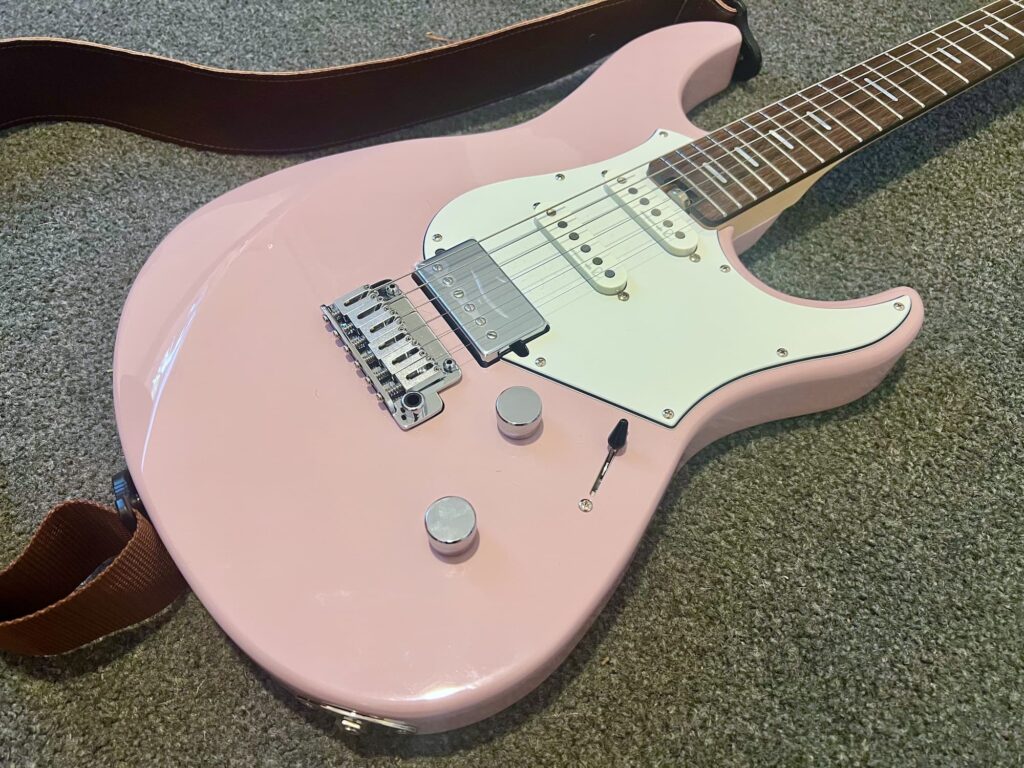
The Yamaha Pacifica Standard Plus is a far cry from the beginner Pacifica you may have started with. The only things it has in common is the general shape and generally good build quality, which all Yamaha products have. But aside from that, this guitar packs so much into a relatively affordable sub-$A1,500 price, it’s ridiculous.
With the PACS+12, you get
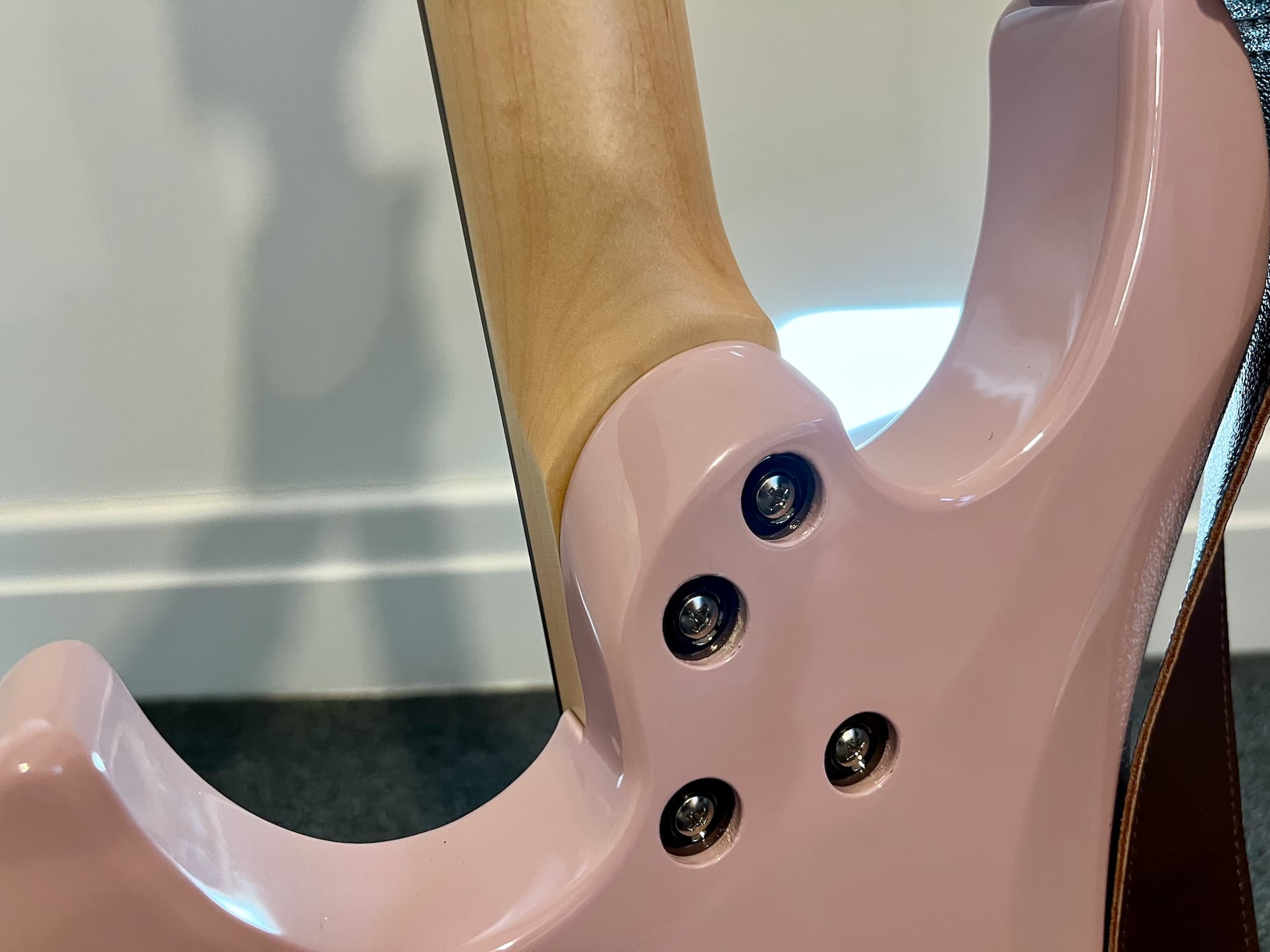
- A carved neck heel (for easy high-fret access)
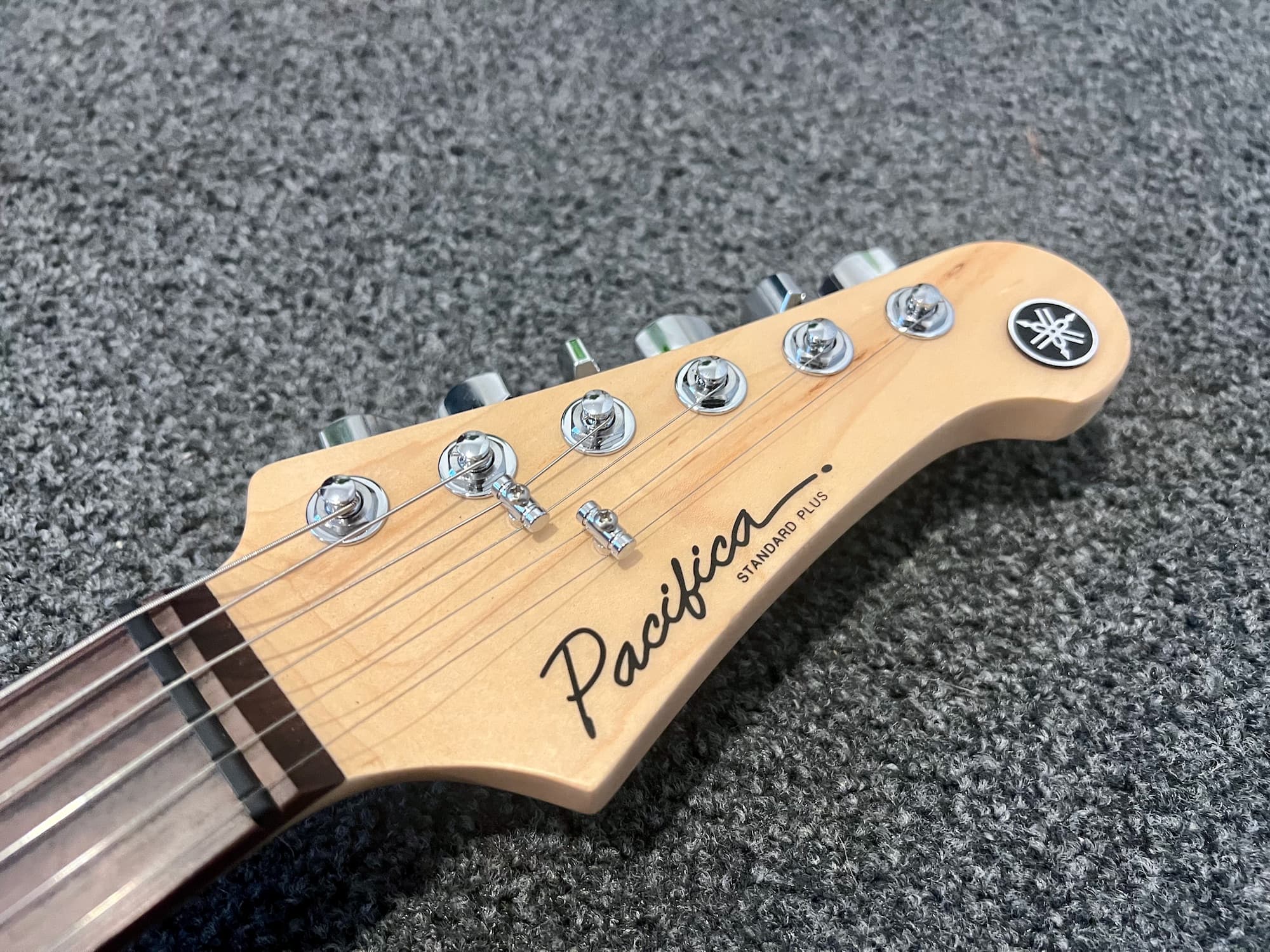
- Gotoh locking tuners (high-end tuners)
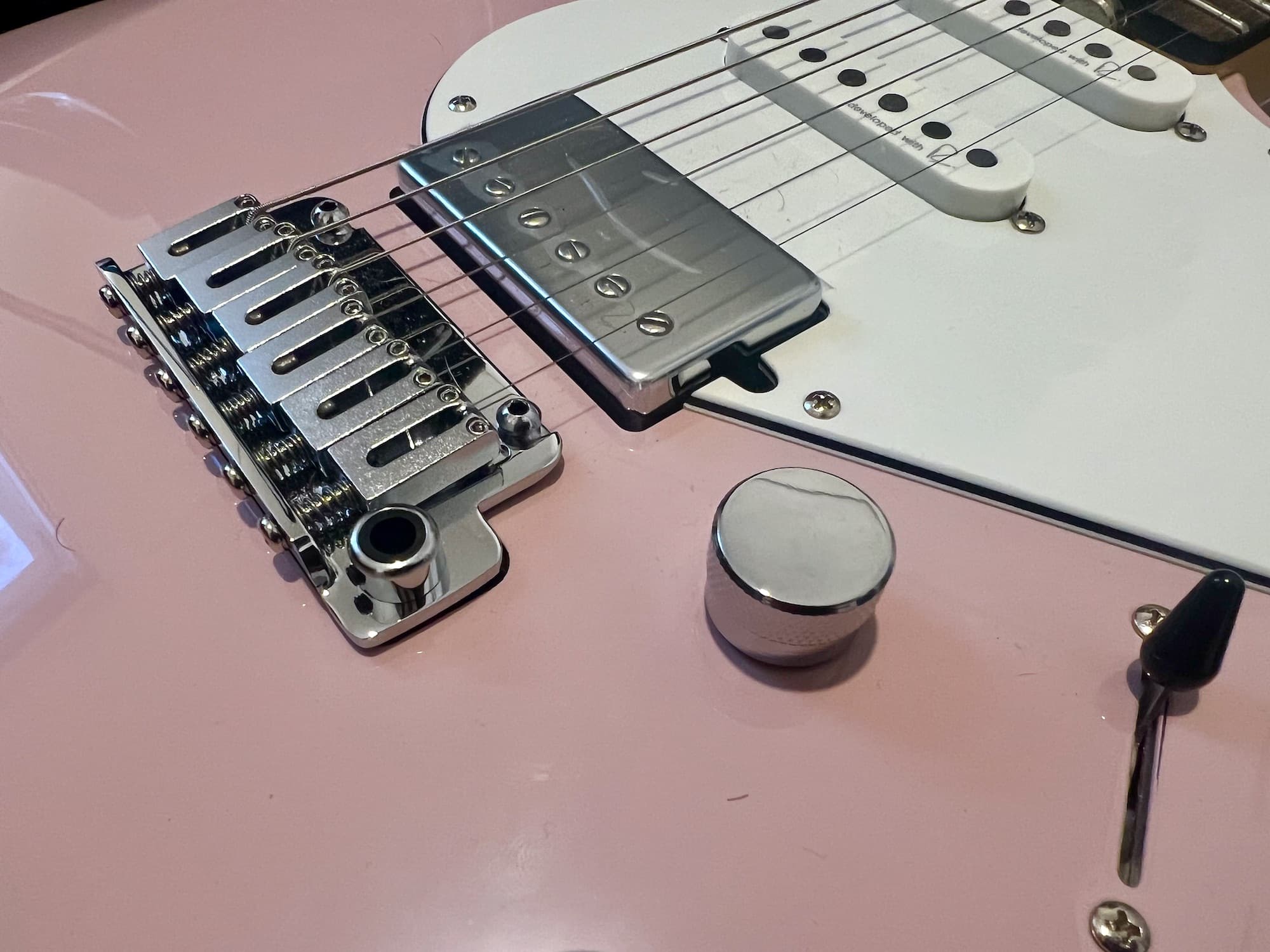
- A Gotoh 2-point tremolo bridge (super comfortable)
- A truss rod adjustment wheel, so you don’t have to mess with hex keys
- Specialised Reflectone pickups designed with Rupert Neve (a specialty music equipment designer) that are clear, low noise, and versatile
- An HSS configuration with coil split on the humbucker (basically the most versatile combination ever)
- Stainless steel frets — very durable
- A versatile 13.8 inch / 350mm radius fretboard (shallow, making for easy bends on high frets)
To give you a sense of how special these features are, you can check equivalent Fender Stratocaster models and see which ones have them.
| Feature on the Yamaha PACS+12 ($1,400 AUD) | Starting equivalent Fender Stratocaster models + market price (AUD) |
|---|---|
| Locking tuners | Fender Player II Modified HSS ($1,550) (Otherwise a $100 upgrade if you install yourself) |
| Shallow radius fretboard | Various specialty models, e.g. Fender Player Plus (discontinued), Aerodyne (discontinued ex-Japan) |
| Carved neck heel | Fender American Professional II $2,500) |
| Stainless Steel Frets | Fender American Ultra Luxe ($3,900) |
| Truss rod adjustment wheel | No current models; formerly American Elite Stratocaster (~$4,000) |
I don’t personally think these features all make a guitar “better”. The ones I think are particularly important are
- The shallow-radius fretboard — I find it easier to play the Pacifica models than most Fender guitars (other than the speciality ones with different radius fretboards). Note that even entry-level Pacifica models have this fretboard profile.
- Stainless steel frets — I love knowing I’ll never have to re-fret my guitar. That’s expensive. The PACS+12 is one of the cheapest guitars with this feature. (Cort and Harley-Bentons are even cheaper.)
- Carved neck heel — I find the blocky heel on most Fenders uncomfortable and irritating. Even cheap Ibanez guitars have a contoured heel.
- Truss rod adjustment wheel — I adjust the truss rod whenever I change strings. Some people never do, though. Using a hex key in the neck always gives me the willies because I wonder if this time, I’ll strip it.
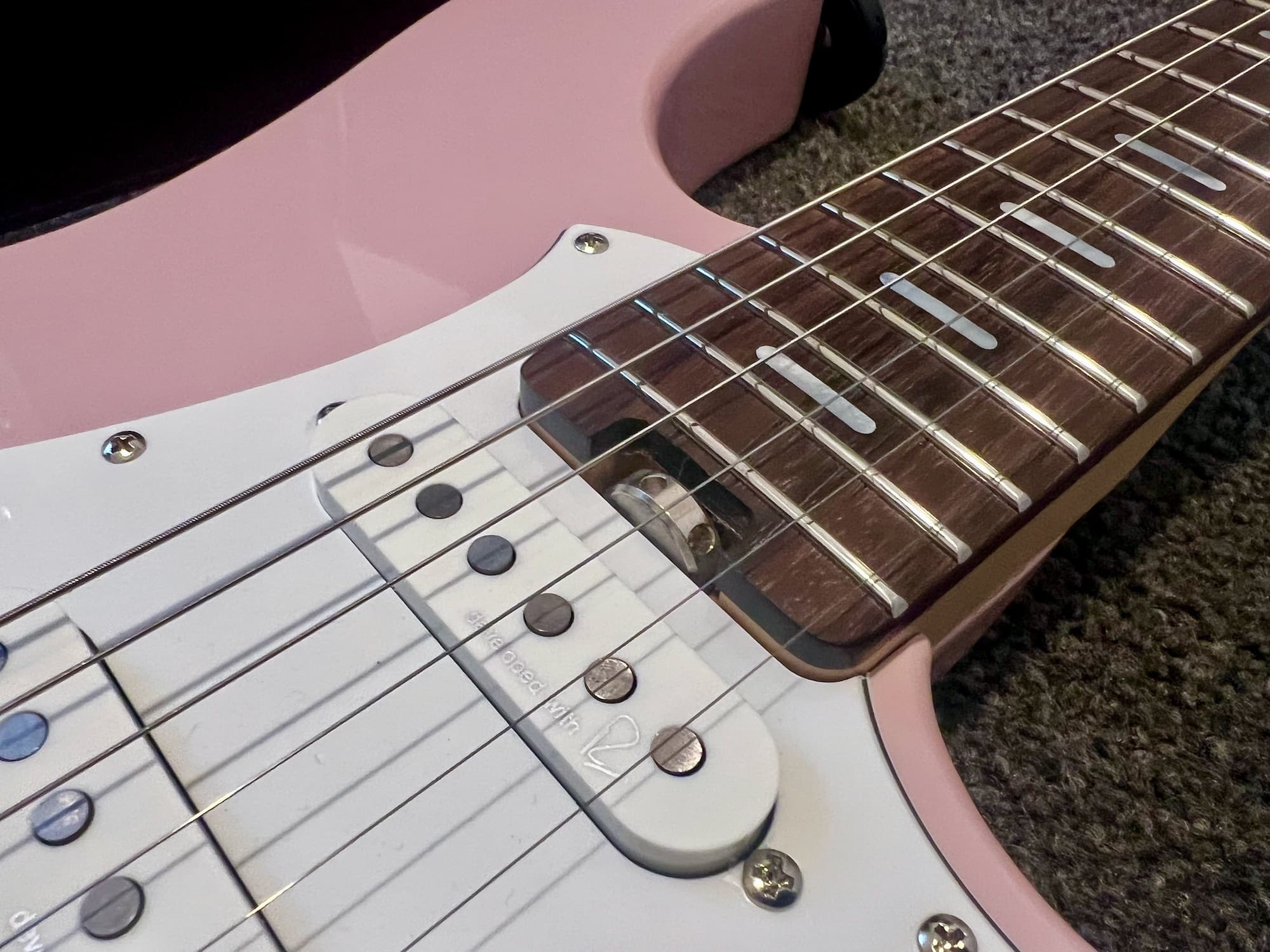
Small note on the truss rod wheel — the instructions Yamaha provides are vague. Looking at the guitar with its bottom down, turn the wheel to the right (clockwise) to tighten the truss rod, bringing the strings closer to the fretboard. Turn the wheel to the left (counter-clockwise) to move strings away from the fretboard, adding relief.
The Pacifica Standard Plus has so much that only the Pacifica Professional brings a couple of extra features, like a compound radius fretboard and the fact that it’s made in Japan (the Standard Plus is made in Indonesia). But I love the neck on the Standard Plus already. It’s comfortable everywhere and so smooth.
Also, the Pacifica Standard Plus comes in pink (“Ash Pink”, to be precise). The Professional doesn’t!
What the Yamaha Pacifica Standard Plus Feels Like
It’s super hard to convey what a Pacifica Standard Plus feels like to play. But here are the impressions I had and continue to have.
The first thing worth noting is that out of the box, the action felt great and the strings bright and clean. I’m so used to having to adjust action on guitars I buy and to change the strings. It was such a pleasant surprise to not have to do either of these! Of course, this is the first guitar I ever bought new…
I find the Pacifica Standard Plus so easy to play. Now, this isn’t a feature unique to this price point. I’ve also felt the same about a second-hand Affinity Strat I bought for $50. But it’s worth acknowledging, nonetheless. I seem to just always hit the right strings and be able to get chords and sequences with ease and speed.
Feel — The neck is wonderfully smooth and easy to grip. Necks are very personal, but this is one of my favourites. I didn’t like the sticky neck on most models of Pacifica 612. There are satin necks on lower spec versions of the Pacifica, though. I do really like the necks on the Pacifica 311 and 112. (The one on the 012 felt a bit rough.)
It has a fairly thin neck. I don’t mind a chunkier one, but I do really like this. It’d be perfect for smaller hands.
One thing to note is that the feel of the Pacifica Standard Plus isn’t that different from satin or smooth necks on cheaper guitars. I’ve also had the pleasure of owning a Yamaha Pacifica 311H, and I think that’s a super underrated guitar — often maligned as the younger sibling of the 611H, but it’s a great guitar in its own right. Anyway, they have similarly amazing necks.
Bridge — I rest my hand on the bridge a lot. I find the bridge to be very comfortable, much more so than Fender Stratocasters I own, which are a bit lumpy, and my Fender Telecaster (with copper saddles), which is downright spiky.
Of course, a tremolo bridge also has to provide a good trem function. The Pacifica’s is no exception – it moves predictably up and down, and returns to tune consistently.
Fretboard — I went out of my way to get a rosewood fretboard. I just liked the look a lot more. I don’t have a strong personal preference between rosewood and maple necks, honestly (I own and enjoy both). But again, this one feel and looks nice.
You might realise I’m struggling with words. It’s not entirely my fault; it’s just that guitars are so damn personal. I think the important thing though, is that I can’t really fault the Yamaha Pacifica Standard Plus. If you like the sound of the features, and you like the look of it, then there’s nothing to stop you.
Can a Yamaha Replace a Fender Stratocaster?
Here’s a controversial viewpoint: No. A Yamaha Pacifica can’t replace a Fender Stratocaster fully.
But there’s a caveat. There are so many kinds of Fender Stratocaster. I have a couple right now, and have had a couple of others (all Americans and Mexicans), and they’ve all been different from each other — different feel and different sound.
Still, Fender is the original, and it’s worth discussing why.
It’s a bit like Harley-Davidsons, for me. Actually, Yamaha tried to beat Harley at that game too, with an awesome line of Virago and Star-branded cruisers that spanned decades. They have a loyal following and are super high quality — in some eras, more so than Harleys. But they’re not Harleys, for various reasons which can be annoyingly glibly summarised as “feel”.
It’s a similar story with Pacificas. They feel great, play great, and do everything “right”. But through a clean amp, they don’t sound the same. And they don’t feel the same.
The controversial thing is that Pacificas may actually feel and sound better for most purposes! But still, it’s not the same thing.
Heck, give me a Yamaha motorcycle over a Harley any day — if all we’re doing is chasing speed, handling, and lap times. But if I want cool factor… I’ll probably get something ridiculous like a Harley-Davidson Night Rod Special. It’s slower, much heavier, insanely loud, and not a great handler (I mean… I crashed one, and it was in part because the bike felt so unfamiliar), but it has a feel that nothing else can imitate.
So the only reason I say a Pacifica can’t replace a Fender Strat is that it isn’t one. Sometimes you’ll hear a Hendrix, Mayer or whatever song and think “hmm, I want to see if I can recreate that”. The best reference for this is a Fender or something else that you know is an “authentic” tone. It might be a cheaper Fender, sure, or even a Squier Affinity, but that’s the best starting point. From there on, you can branch out to Pacificas.
For that reason, I’ve kept at least one Fender Stratocaster in my stable. I may not play it as much, but it’s there for when I really want to know I’m as close as possible.
Wrap up
If you have the dough, and if you’re on the fence about the Paciufica Standard Plus — don’t hesitate.
Pretty much the only downside to the Pacifica Standard Plus is the branding. It’s a Yamaha. Your guitar is known for ruthless pursuit of efficiently making consistent, high-quality equipment.